Think about the last time you were in the middle of a recipe and needed to know right now what “fold in the cheese” actually means.You don’t want to stop everything, find a cookbook, and read a whole chapter on cooking techniques. You just need that one specific piece of information, at that exact moment.
That’s the simple, powerful idea behind Just-in-Time (JIT) training. It’s all about delivering small, focused, and highly relevant bites of knowledge directly into an employee’s workflow, precisely when they hit a roadblock or need to learn a new step.
Understanding Just In Time Training
Instead of pulling everyone away from their work for a long “just-in-case” training session—where most of the information is forgotten by next Tuesday—JIT training integrates learning directly into the job. It gives your team the power to solve problems on their own, boosting their confidence and getting them back to being productive in minutes, not hours.
It’s like having a GPS for your job. You don’t need the entire map of the country; you just need the next turn, right when you need to make it.

From The Factory Floor To The Modern Workplace
The whole “just-in-time” concept isn’t new. It actually started on the factory floors of Toyota back in the 1950s. Their goal was to make manufacturing more efficient by getting parts to the assembly line exactly when they were needed, not a moment sooner. No more stockpiles, no more waste.
We’ve just applied that same razor-sharp principle to knowledge. Why stockpile information in an employee’s brain with a full-day seminar when you can deliver the exact answer they need, right at their fingertips?
The benefits of this approach are immediate and obvious:
- Knowledge That Actually Sticks: When you learn something and apply it five seconds later, you’re far more likely to remember it. The dreaded “forgetting curve” doesn’t stand a chance.
- A Major Productivity Boost: Less time is spent digging through old emails, searching a clunky knowledge base, or tapping a coworker on the shoulder. The answer is right there, within the workflow.
- Become More Agile: Need to roll out a software update or a new process? JIT learning lets your team get up to speed on the fly, without ever stopping their work.
In essence, Just in Time training moves learning from a scheduled event to a continuous, integrated part of daily work. It respects an employee’s time by delivering only the necessary information, precisely when it’s most valuable. This shift is a game-changer for modern teams. Roles change, software gets updated, and customers ask new questions every day. By weaving learning directly into the flow of work, you build a more self-sufficient, capable, and confident team that can handle whatever comes its way.
The Business Case For On-Demand Learning
Let’s move beyond the theory and talk about what Just-in-Time (JIT) training actually does for your bottom line. This isn’t just a “nice-to-have” for employees; it’s a powerful tool for business growth. When your team can find and use information the moment they need it, they completely sidestep the dreaded “forgetting curve.” The result is a massive leap in knowledge retention and real-world job performance.
What does that look like day-to-day? It means fewer mistakes, less time wasted hunting for answers, and a serious bump in productivity.
Think about a support agent who pulls up a troubleshooting video mid-call to solve a customer’s problem on the spot. Or a sales rep who watches a quick feature demo right before walking into a huge client meeting. These aren’t just abstract ideas—they’re tangible, daily wins.
Driving Measurable Outcomes
These moments show how JIT training makes the whole organization more agile and speeds up onboarding. New hires don’t have to wait around for the next formal training session; they can find what they need to get up to speed and start contributing almost immediately. And that has a direct impact on the numbers that matter.
This whole approach was borrowed from the JIT inventory model in manufacturing, which was designed to cut out waste. It’s now a key part of modern corporate learning for the same reason. In fact, a whopping 65% of companies say it significantly improves their training effectiveness, and 72% of employees actually prefer learning this way, right in their workflow.
This is a direct counterpunch to the harsh reality that people can forget up to 90% of what they learn in a formal session within just one week.
Ultimately, this all leads to concrete results you can actually track, like:
- Higher customer satisfaction scores
- Faster problem resolution times
- Increased employee confidence and autonomy
A Strategic L&D Advantage
When you build an on-demand learning system, you’re really investing in a more resilient and capable workforce. It becomes a core part of a modern learning and development strategy, giving your teams the ability to adapt to new products, shifting processes, and evolving customer needs with incredible speed. Grasping the technology behind it all, like what goes into an online learning platform app, helps clarify the full business case.
By putting answers right at your team’s fingertips, you empower them to not only do their own jobs better but also to share their knowledge more effectively. JIT turns learning from a scheduled, one-off event into a continuous, integrated part of the job. This fosters a culture of self-sufficiency and constant improvement that benefits the entire organization.
Where Just-In-Time Training Really Shines
While the idea of learning on demand sounds great for just about anyone, where does it actually make a difference? Just-in-time training isn’t just a nice-to-have; it’s a game-changer for teams that live in fast-paced, information-rich environments. For these roles, getting the right answer at the right moment is mission-critical.

This is where learning stops being a theory and becomes a practical tool for getting things done. It thrives wherever speed and accuracy are the name of the game.
For Customer Support and Success Teams
Think about a support agent on a live chat with a customer who’s getting more frustrated by the second. Instead of putting them on hold to dig through a clunky knowledge base, the agent gets a pop-up with a quick video walking them through the exact fix. That’s JIT training in its element.
- Faster Ticket Resolution: Agents get the precise, visual guidance they need to cut down problem-solving time.
- Increased First-Contact Resolution: When answers are instant, agents can solve issues on the first try, which is a huge driver of customer satisfaction.
- Consistent Service Quality: Every agent, new or veteran, has access to the same expert-approved information, creating a dependably great customer experience.
This on-demand access essentially turns every support agent into a product expert, giving them the confidence and know-how to handle almost anything a customer throws at them.
For Sales Enablement and L&D
In sales, timing is everything. A rep about to jump on a demo call can pull up a two-minute video that breaks down a competitor’s key weakness or highlights a new feature’s main selling point. This is how JIT training helps sales teams close more deals.
Learning & Development (L&D) teams also rely on it to roll out new software, like a CRM or internal tool. Instead of pulling everyone into a long, one-off training session that they’ll forget in a week, L&D can create bite-sized guides that employees access right when they get stuck on a new task in the platform.
A Smarter Way to Create On-Demand Video
The biggest roadblock is often creating all this high-quality, bite-sized content without a huge time investment. A quick screen recording made with a tool like Loom is often 50-100% longer than it needs to be, full of awkward pauses and “ums” and “ahs.” But firing up professional software like Adobe Premiere Pro or Camtasia requires a video editing expert and just isn’t fast enough for JIT needs.
This is exactly where a tool like Tutorial AI comes in. It lets your subject matter expert simply talk and record a demo, onboarding flow, or support guide. Then, the AI steps in and automatically transforms that raw footage into a polished, professional-looking tutorial. It feels like it was edited in Premiere Pro, but it takes a fraction of the time.
This means your internal experts can churn out knowledge base videos, product explainers, and feature updates with incredible efficiency, making a truly effective JIT training program a reality.
Creating Powerful JIT Content With AI
Let’s be honest: the biggest hurdle to a great just-in-time training program is creating the content. For JIT to work, you need high-quality, bite-sized videos and guides that can be produced almost instantly. This is where most programs fall apart.
You’re usually stuck between two bad options. On one side, you have simple screen recorders like Loom. They’re easy, but you end up with videos that are 50-100% longer than they need to be, full of filler words and rambling. On the other side, you have pro tools like Adobe Premiere Pro or Camtasia. They produce beautiful results, but they demand a ton of time and an expert video editor—the very things you don’t have in a JIT world.
Bridging The Gap With AI Video Generation
This content bottleneck is exactly what AI-powered tools were built to solve. They act as the bridge between quick-and-dirty recording and a polished, professional final product. Suddenly, your subject matter experts—the people with the actual knowledge—can create amazing content without ever touching a complex editing timeline.
A platform like Tutorial AI is a perfect example of this. It generates video tutorials based on screen recordings. Easy to use recording via tools such as Loom is often 50-100% longer than necessary. Professional video editing software such as Camtasia or Adobe Premiere Pro requires expert video editing knowledge. Tutorial AI’s tools let you speak freely without any practice and your video will still look professional as if it was edited in Adobe Premiere Pro.
Here’s a quick look at how Tutorial AI turns a messy recording into a finished video.
See how the text transcript on the left controls the video on the right? This completely removes the need for traditional timeline editing, empowering your internal experts to produce incredible JIT content at speed.
From Raw Recording To Polished Tutorial
The real magic is in the editing. The AI generates a perfect transcript of everything you said, and from there, editing the video is as simple as editing a text document. Delete a sentence from the transcript, and the corresponding video and audio are instantly cut. The AI voiceover then smooths out the narration and perfects the timing automatically.
This allows the subject matter expert to create on-brand videos extremely efficiently. It opens the door for your team to create all sorts of JIT content, like:
- Demos and Explainer Videos: Quickly show off a new software feature with a crystal-clear walkthrough.
- Onboarding Videos: Build a library of essential guides for new hires to watch whenever they need them.
- Knowledge Base Videos and Support Article Videos: Transform dense support docs into visual guides that are much easier to follow.
- Feature Release Videos: Get everyone on the same page with consistent, polished videos about new updates.
By taking away the technical hurdles, you can finally scale your JIT training. If you’re ready to build out your library, you can learn more about how to create training videos with AI and truly support your team’s on-demand learning needs. This is how JIT training moves from a nice idea to a practical reality.
A Step-By-Step Framework for Launching JIT Training
So, you’re ready to build your own just-in-time training program? Great. It doesn’t have to be a massive, complicated undertaking. Let’s break it down into a practical framework that takes you from a blank slate to a successful, scalable program.
First things first, you need to identify critical knowledge gaps. This is where you put on your detective hat. Dig into your data—what are the most common support tickets? What questions pop up repeatedly in sales call recordings? You can even just survey your team to find out exactly where they get stuck. These “moments of need” are pure gold for your content strategy.
Once you know what your team needs help with, the next question is how to deliver that help. Should it be a quick, two-minute video tutorial? Or maybe an interactive checklist would hit the mark? The key is to create content that’s quick to digest and solves one specific problem, right then and there.
Choosing The Right Tools and Platforms
With a solid content plan, it’s time to think about technology. A crucial piece of the puzzle often involves a robust Learning Management System Integration, which helps you track and deliver everything smoothly.
A great JIT program feels invisible. It seamlessly weaves training materials into the places your team already works. Think about embedding a help video directly into your CRM or dropping a link to a guide right inside the software they use every day. The goal is to make finding an answer a natural part of the workflow, not an interruption.
Modern tools have made creating this kind of content incredibly simple.
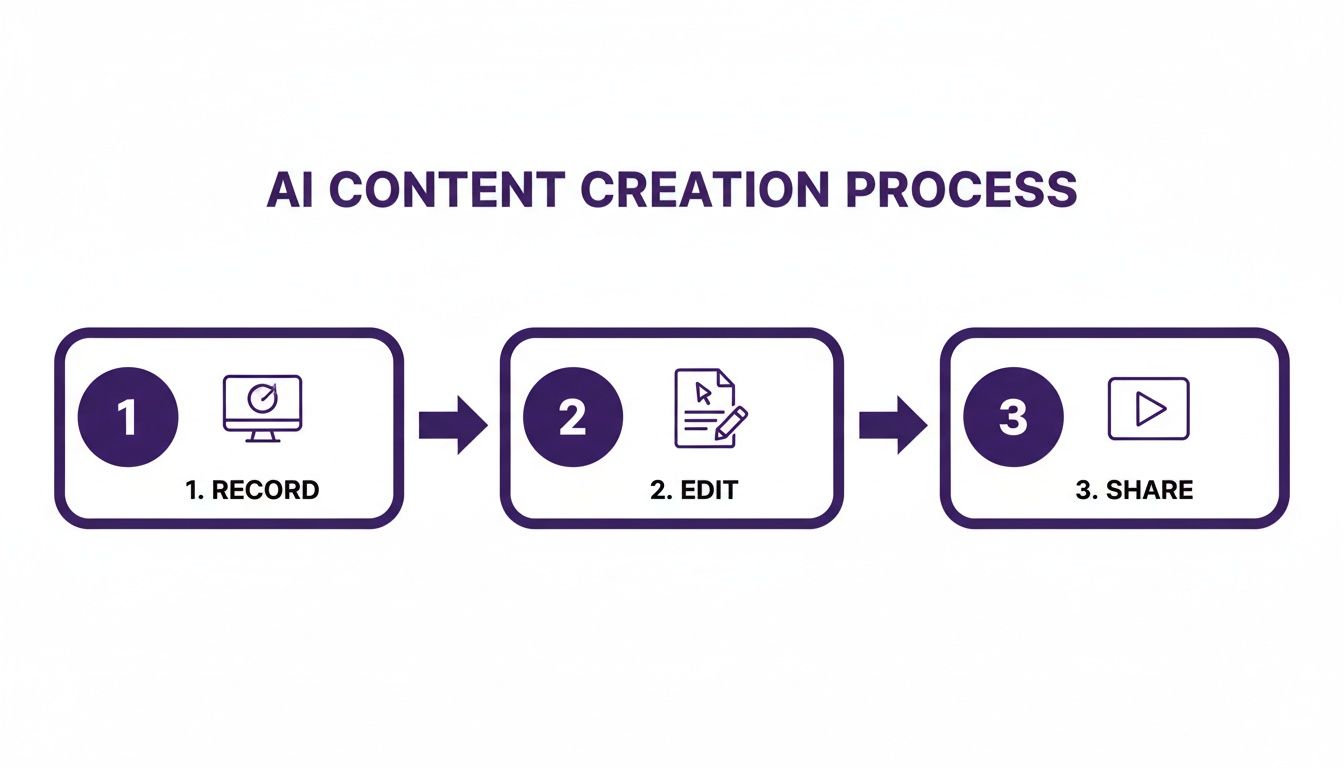
What used to be a complex, multi-stage process has been boiled down by AI-powered tools into a simple three-step flow that pretty much anyone can master: record, edit, and share.
Starting Small and Scaling Success
The global workplace training market is massive, hitting $401 billion in 2024, and JIT learning is a huge reason why. Why the boom? Because online JIT formats can boost knowledge retention by up to 80% compared to old-school training sessions. This means employees can spend 40-60% less time studying while actually seeing 15-25% gains in their performance.
The best way to begin is to launch a small pilot program. Choose one team or one specific workflow, create a few targeted JIT assets, and measure the impact. Keep a direct line of communication open with your pilot group. Their feedback is invaluable for refining your content and delivery. Once you’ve proven the concept on a small scale, you’ll have a rock-solid case study to get buy-in and scale your program across the entire organization.
How to Measure the Success of Your JIT Program
A training program is only as good as the results you can prove. If you want to show the real ROI of your just-in-time training, you have to look past simple numbers like completion rates. The metrics that truly matter to leadership are the ones tied to tangible business outcomes.
It’s about connecting the dots between your JIT content and actual on-the-job performance. Instead of just tracking who watched a video, you need to measure the impact that video had. A well-executed JIT program isn’t a cost center; it’s a strategic investment that drives efficiency and moves the needle on key business goals.
Key Performance Indicators to Track
The right KPIs will always be specific to the team you’re supporting. For a customer support team, for instance, a fantastic metric is a drop in the average ticket resolution time after you launch a new series of troubleshooting videos.
For other teams, you might want to look at:
- A decrease in employee error rates: When people can pull up the correct procedure in seconds, mistakes naturally plummet.
- Faster onboarding for new hires: Track the time it takes for a new team member to hit full productivity. JIT support can shave weeks off this ramp-up period.
- Increased product adoption: Did usage of that new feature spike right after you released a few JIT explainer videos? That’s a clear win.
- Higher sales conversion rates: For sales teams, you can measure if reps who access on-demand battle cards are actually closing more deals.
The growth in this space is undeniable. Just-in-Time Training Nudges now make up a corporate learning market valued at $1.18 billion globally in 2024. For a sales team, this means a rep can pull up a specific product demo right in the middle of a client call, potentially cutting their response time by up to 50%. You can discover more about these market insights and see how they’re reshaping modern sales strategies.
When you can draw a straight line from a specific JIT asset to a concrete business result, you build a powerful, undeniable case for your program’s value. For a deeper dive into this topic, check out our guide on how to measure training effectiveness.
Got Questions About Just-In-Time Training?
If you’re thinking about bringing a just-in-time training strategy into your organization, you probably have a few practical questions. Let’s clear up some of the most common ones to help you sidestep potential hurdles and get your program off the ground.
How Is JIT Training Different From Microlearning?
This is a great question, and the answer is simple: they work together. They aren’t competing ideas.
Microlearning is all about the format. It’s the practice of creating short, highly-focused pieces of content, like a quick two-minute video or a simple checklist.
JIT training is all about the delivery strategy. It’s the art of getting that content to someone at the precise moment they need it. Think of it like this: microlearning is the “what” (the bite-sized tutorial), and JIT is the “when” (popping that tutorial up right when a sales rep is trying to log a call in the CRM).
Does JIT Training Replace All Formal Training?
Absolutely not. JIT is a powerful way to provide on-the-job support and reinforce what people have already learned, but it’s a supplement to foundational training, not a replacement.
You still need structured, in-depth programs for complex skills and comprehensive onboarding. Where JIT shines is supporting employees with specific tasks long after that initial training is over, making sure the knowledge actually sticks when it matters most.
What Is The Biggest Challenge In Implementing JIT Training?
The biggest hurdles are usually twofold: figuring out the real moments of need and then creating high-quality content fast enough to be useful.
If your content creation process becomes a bottleneck, it completely defeats the “just-in-time” purpose. This is exactly why having the right tools is a game-changer. Modern platforms allow your own experts to quickly create polished videos and guides, closing the gap between spotting a knowledge gap and delivering a solution.
Creating on-demand video content is often the biggest blocker to effective JIT training. With Tutorial AI, your subject matter experts can just record their screen, and our AI instantly turns it into a polished, professional tutorial in minutes. Discover how Tutorial AI makes JIT training a reality.