A learning and development strategy is the master plan that connects where your people are today with where your business needs to be tomorrow. It’s about moving beyond scattered, one-off training sessions and deliberately building a program where every single learning opportunity helps close a skill gap, drive performance, and build a culture of constant growth.
When done right, employee development stops being a line item in the budget and becomes a direct engine for organizational success.
What Is a Learning and Development Strategy
It’s easy to mistake an L&D strategy for a simple training calendar, but it’s so much more. Think of it as your company’s internal GPS for talent. It’s the high-level roadmap that ensures every learning activity—from a new hire’s first day to a senior leader’s coaching program—serves a very specific business goal. Instead of just reacting to skill shortages as they pop up, a solid strategy helps you anticipate and build the capabilities your teams will need for future challenges.
This is what shifts training from a cost center to a powerful strategic investment. The connection between growth opportunities and employee loyalty is undeniable. A 2021 Pew Research study revealed that a staggering 63% of employees who left their jobs did so because of a lack of advancement opportunities—a reason that even beat out low pay.
The Core Purpose of an L&D Strategy
A truly effective L&D strategy is designed to do far more than just transfer information; it’s about nurturing a workforce that is adaptable, engaged, and ready for what’s next. At its heart, the strategy aims to:
- Align Learning with Business Goals: Ensure every workshop, course, or coaching session directly contributes to a key objective, like breaking into a new market or boosting customer retention.
- Close Critical Skill Gaps: Systematically identify the skills your team has today versus what they’ll need in the future, then create targeted programs to bridge that divide.
- Boost Employee Engagement and Retention: Show your people you’re invested in their careers. That investment builds loyalty and dramatically reduces costly turnover.
- Foster a Culture of Continuous Learning: Make learning a part of the daily workflow, not just a once-a-year event. It encourages everyone to take ownership of their own growth.
A robust L&D strategy is the bridge between individual potential and organizational performance. It sends a clear message to employees that their growth is essential to the company’s future, turning them into active partners in its success. Ultimately, this proactive approach creates a more agile organization that can pivot and adapt to change. A key piece of this puzzle is having clear and consistent /b/documentation-of-training, which ensures every program is delivered effectively. For more forward-thinking ideas, it’s also worth checking out these 12 effective learning and development strategies for 2025.
The Four Pillars of an Agile L&D Framework
To build a learning and development strategy that actually works, it needs to stand on a solid foundation. Think of it like a building—without strong structural supports, it’s unstable. Your L&D efforts need a framework to keep them effective, stable, and pointed directly at your company’s mission. These four pillars provide that essential structure, turning random acts of training into a cohesive, results-driven program.
An agile framework helps you keep up with the constant shifts in the modern workplace. It’s about building a system that is both sturdy and flexible, ready to meet today’s needs while preparing for tomorrow’s challenges.
Let’s break down each of these foundational pillars.
Business Alignment
First and most importantly, we have Business Alignment. This simply means that every single learning initiative must directly support a specific company goal. Training for the sake of training is a surefire way to waste time and money. Training that solves a real business problem? That’s a strategic investment.
For instance, imagine your company is launching a new software product. A business-aligned L&D strategy wouldn’t be a generic “software skills” course. Instead, you’d create targeted training for the sales team on selling its new features, for the support team on troubleshooting common issues, and for customers on getting the most out of the upgrade. The learning directly fuels the success of a major company priority.
Learner-Centric Design
Next up is Learner-Centric Design. This pillar is all about shifting the focus from what the company wants to push out to what employees actually need and how they genuinely learn. It’s about creating experiences people want to be a part of, not just something they have to sit through. This means offering learning that fits into the flow of their day, whether it’s a quick microlearning video or a hands-on workshop.
You have to consider how people learn today. While 58% of employees say they prefer to learn at their own pace, programs that mix that freedom with collaborative, group-based elements see 32% higher completion rates. This shows why a hybrid approach—one that respects individual styles while also building community—is so effective. You can discover more insights about employee training statistics and see how these blended models are reshaping corporate learning.
Ultimately, this approach confirms that the one-size-fits-all model is dead. An engineer might need a deep technical walkthrough, while a marketing manager could get more value from a discussion built around a real-world case study. Making the experience relevant is what drives engagement and makes knowledge stick.
Scalable Delivery
The third pillar is Scalable Delivery. Your L&D strategy has to be able to reach every employee, no matter where they are, what their role is, or when they work. For any modern organization with distributed teams, this is where having the right technology and methods becomes non-negotiable.
An L&D strategy without a scalable delivery mechanism is like a brilliant lecture given in an empty room. The value is lost if it doesn’t reach its intended audience efficiently and consistently. Scalability isn’t just about reaching more people; it’s about doing it efficiently without the quality dropping off. This could mean using a robust Learning Management System (LMS), building a library of on-demand video tutorials, or even creating a train-the-trainer program to empower local leaders. The goal is to provide a consistent, high-quality learning experience for everyone, from a new hire in a regional office to a senior leader at headquarters.
Data-Driven Measurement
And finally, Data-Driven Measurement is what tells you if any of this is actually working. This pillar is about moving beyond simple metrics like who completed a course. It’s about digging deeper to see the real-world impact of your programs. It answers the one question that matters: “Did the training change behavior and improve business results?”
Effective measurement ties learning outcomes directly to key performance indicators (KPIs). For example, after running a communication skills workshop for managers, you could start tracking metrics like employee engagement scores and team retention rates over the next few quarters. When you can show a clear return on investment (ROI), securing ongoing support and resources for your learning and development strategy becomes a whole lot easier.
Your Five-Step Plan for Implementing an L&D Strategy
A brilliant learning and development strategy on paper is useless if it doesn’t translate into action. Turning that high-level vision into a program that actually drives results requires a clear roadmap. This five-step plan will walk you through the process, taking you from initial analysis to continuous improvement.
Think of it as building a house—each step lays the foundation for the next, creating a solid structure for developing your people and hitting your company goals.
Step 1: Conduct a Thorough Needs Analysis
Before you can build anything, you need a blueprint. A needs analysis is that blueprint. It’s where you dig in and find the specific knowledge, skills, and behavioral gaps that are holding your organization back. It’s all about asking the right questions to find the most critical training needs.
This isn’t about guesswork; you need to gather real data from a few different angles to get the full picture.
- Organizational Level: What skills do we absolutely need to achieve our biggest goals, like breaking into a new market or making our operations more efficient?
- Team Level: Which departments are struggling to hit their KPIs? Are there common roadblocks that the right kind of training could remove?
- Individual Level: What do our employees want for their own career growth? What are managers flagging in performance reviews?
Getting this discovery phase right ensures your L&D budget and effort go toward solving the problems that matter most.
Step 2: Design the Learning Journey
Once you know what skills to target, it’s time to design the experience. This is so much more than just picking a course. It’s about mapping out a complete journey with clear, measurable learning objectives. A great design answers the simple question: “What should someone be able to do after this training that they couldn’t do before?”
For every gap you identified, you have to define what success looks like. For example, an objective for a sales training program could be: “By the end of the quarter, participants will be able to demo the product’s top three features and increase their lead conversion rate by 15%.” Suddenly, the outcome is tangible and tied directly to a business metric.
Step 3: Develop and Curate Content
With a solid design in place, you can finally build or find the actual learning materials. This stage demands a thoughtful approach. You need content that’s not just informative but also engaging and easy for a modern workforce to consume. You really have two main choices here: create custom content or curate existing resources.
Creating custom content is perfect for your company’s unique processes or internal knowledge. A fantastic way to scale this is by using Tutorial AI to generate video tutorials based on screen recordings. We’ve all seen it—a quick demo recorded with a tool like Loom is often 50-100% longer than necessary, filled with pauses and mistakes that make viewers tune out. On the other side, professional video editing software like Camtasia or Adobe Premiere Pro requires expert knowledge that most subject matter experts (SMEs) don’t have.
Tutorial AI’s tools let you speak freely without any practice and still your video will look professional as if it was edited in Adobe Premiere Pro. It bridges this gap, allowing an SME to create on-brand demos, onboarding videos, explainer videos, feature release videos, knowledge base videos, and support article videos extremely efficiently.
Step 4: Deliver the Training Effectively
How you deliver your training is just as important as the content itself. This phase is all about choosing the right channels to reach your learners where they are, in a format that fits their workflow. Technology is your best friend here, helping you create a seamless and scalable learning ecosystem.
A huge part of this is picking the right tools. A great place to start is by exploring the best Learning Management Systems (LMS) to manage, deliver, and track your programs. A good LMS acts as the central hub for all your training, and you can learn more about what a strong learning management system integration can do in our detailed guide.
This diagram shows a modern, agile framework for bringing all these pieces together.
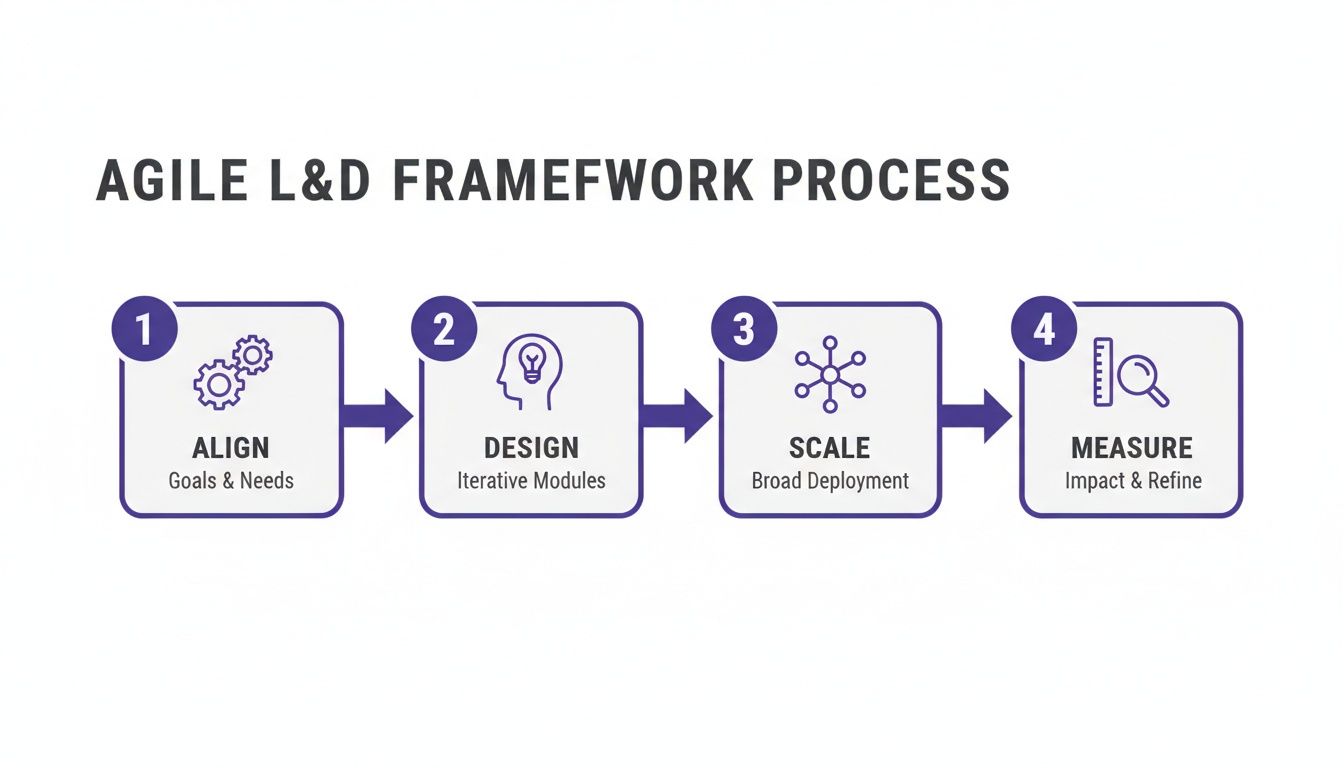
You can see how each stage connects, reinforcing that L&D isn’t a one-time project—it’s a continuous cycle.
Step 5: Measure and Iterate for Improvement
Finally, a successful learning and development strategy is never finished. The last step is a constant loop of measurement, feedback, and iteration. This is where you dig into the data to figure out if your training is actually working and delivering a return on investment.
Use a mix of numbers and stories to get the full picture. Track performance metrics, send out feedback surveys, and hold quick debriefs with learners and their managers. Use what you learn to tweak your content, adjust your delivery methods, and make sure your L&D program keeps evolving right alongside your business.
Using AI-Powered Video to Scale Your Training
Let’s be honest: creating high-quality, engaging training content is a massive bottleneck for most learning and development teams. It’s one of those areas where you need to scale up your efforts without letting the quality slide. And while video is the undisputed king of training content, the actual process of making it has always been a pain.
The problem is the frustrating trade-off between simplicity and professionalism. On one side, you have simple screen recorders like Loom. They’re great for quick, informal updates, but the final product is often 50-100% longer than it needs to be. These raw recordings are usually full of long pauses, mistakes, and repetitive clicks that make viewers tune out fast.
On the other side, you have the heavy hitters—professional editing software like Adobe Premiere Pro or Camtasia. These tools can create beautiful, polished videos, but they demand a level of expertise and time that most subject matter experts (SMEs) and L&D pros just don’t have. So you’re stuck with a tough choice: get it done fast but unpolished, or get it done right but slowly and expensively.
Bridging the Gap with AI-Powered Video Creation
This is where AI-driven platforms like Tutorial AI are completely changing the game. They finally close that gap, giving your internal experts the power to create studio-quality videos without the usual hassle. An SME can now just hit record, capture their screen, and explain a process naturally, without needing a perfect script or multiple practice runs.
The AI does all the heavy lifting. It automatically trims the raw footage down to a professional standard, snipping out the awkward silences, the “ums” and “ahs,” and all those redundant mouse movements. It transforms a rambling screen recording into a tight, focused, and genuinely engaging tutorial.
This approach puts high-quality video creation in the hands of anyone, removing the editor from the critical path. The person with the knowledge can finally be the person who creates the finished training asset, which means everything gets done faster and more accurately.
Empowering Subject Matter Experts to Become Creators
The real magic here is putting the creation tools directly into the hands of the people who know the material best—your subject matter experts. Instead of waiting weeks for a video production team to free up, an SME can now create a polished video in just a few minutes for all kinds of crucial training needs.
- Product Demos: Your sales and support teams can create crystal-clear demos that show off key features without any distracting mistakes.
- New Hire Onboarding: You can build a library of consistent, on-brand onboarding videos that new hires can watch whenever they need to.
- Feature Release Videos: Need to get everyone up to speed on new software features? An SME can quickly make an explainer video for the whole company.
- Knowledge Base Videos: Bolster your internal and external knowledge bases with visual, step-by-step videos that cut down on support tickets.
By enabling SMEs to record their screen and speak freely, Tutorial AI ensures the final video looks as if it was professionally edited in Adobe Premiere Pro. This allows non-editors to produce concise, on-brand content that respects the viewer’s time and attention. This kind of speed is essential today. The push to bring smarter tech into L&D is picking up steam. In fact, a recent study found that 55% of organizations are making generative AI and machine learning a priority in their leadership development plans for 2025. This signals a huge shift away from traditional methods that just can’t keep pace. You can read the full research about these leadership development findings to see the bigger picture.
And it’s not just the video that gets an upgrade; the audio does too. An AI-powered voiceover can deliver a perfect narration every time, stripping out background noise and keeping the tone consistent across all your training materials. If you’re trying to scale your content for a global audience, you might want to check out our guide on using an AI voice generator for videos to produce multilingual content with ease. This is the kind of capability that defines a modern, scalable learning and development strategy.
How Do You Know if Your L&D Program is Actually Working?
Let’s be honest: a learning and development strategy without a way to measure its success is really just a shot in the dark. To get buy-in from leadership and prove that your efforts are worthwhile, you have to look past simple course completion numbers and dig into the real impact on the business. The goal is to draw a straight line from a training program to a concrete business win.
This is what elevates L&D from a simple cost center to a true strategic partner. When you can walk into a meeting and show exactly how a specific training improved team performance, cut down on costs, or even helped drive revenue, L&D becomes a non-negotiable part of the company’s growth engine.
Moving Beyond “Happy Sheets”
For a long time, the gold standard for L&D success was what we call “vanity metrics.” Think about it: how many people signed up? How many finished the course? What did they score on the satisfaction survey? While this stuff is easy to track, it tells you almost nothing about whether the training actually made a difference.
Sure, knowing 95% of employees finished a course is a nice data point. But it leaves the most important questions unanswered. Did they really learn anything new? Did they start doing things differently at their desks? And, crucially, did those changes move the needle for the business? To find those answers, you need a more thoughtful approach.
A Better Framework: The Kirkpatrick Model
This is where the Kirkpatrick Model comes in. It’s a tried-and-true method used worldwide to evaluate training effectiveness. The model breaks measurement down into four clear levels, with each one giving you a deeper, more valuable look at your program’s impact. It’s like climbing a ladder—each rung offers a better view.
This framework gives you a practical roadmap for checking the pulse of your learning and development strategy from start to finish.
The Kirkpatrick Model forces us to ask bigger, better questions. We stop asking, ‘Did they like it?’ and start asking, ‘Did it improve our business?’ That’s how you prove the real ROI of learning. Let’s break down each of the four levels.
- Level 1: Reaction. This is the ground floor. It simply measures how people felt about the training. Was it engaging? Did the content feel relevant to their job? You’ll usually gather this with feedback forms or quick surveys right after a session. A positive reaction is a great first step because if people are bored or frustrated, they’re not going to learn much.
- Level 2: Learning. Okay, they liked it—but did they learn anything? Here, you’re assessing whether your team actually picked up the knowledge or skills you intended. This can be measured with pre- and post-training quizzes, practical tests, or even hands-on demonstrations to see what new skills they can show off.
- Level 3: Behavior. This is where the rubber meets the road. Are people taking what they learned in the training room and applying it to their daily work? This level is all about turning knowledge into action. You can measure this through manager observations, 360-degree feedback, or performance reviews a few weeks or months down the line.
- Level 4: Results. This is the top of the ladder—the ultimate measure of success. It connects the training directly to tangible business outcomes. Did that sales training actually lead to more closed deals? Did the new customer support videos cause a drop in service tickets? This level is all about tracking the key performance indicators (KPIs) you set out to influence from the very beginning.
KPIs That Genuinely Matter
To measure anything at Level 4, you have to know what you’re aiming for before the training even starts. The metrics you choose should be directly tied to the problem you were trying to solve in the first place.
Here are a few powerful KPIs to get you started:
- Improved Employee Performance: Look at specific, job-related numbers—things like sales figures, customer satisfaction scores, or production output. For example, a software company could see if a new product training leads to a 10% increase in upsells from the sales team.
- Reduced Time-to-Proficiency: How long does it take a new hire to get fully up to speed? A great onboarding program should significantly shorten this timeline, which saves the company money and gets new team members contributing faster.
- Higher Employee Retention Rates: It’s no secret that people stay at companies that invest in their growth. Keep an eye on turnover rates, especially in departments that have gone through a lot of training. A 5% reduction in turnover in a critical department can add up to huge cost savings.
Common L&D Strategy Pitfalls and How to Avoid Them

Knowing what not to do is just as important as knowing what to do. Even the most well-meaning learning and development strategy can get tripped up by predictable roadblocks. If you can anticipate these challenges, you’re in a much better position to build a program that actually delivers results instead of just eating up the budget.
One of the biggest mistakes I see is a total disconnect between training initiatives and the company’s real business goals. When L&D works in a vacuum, it produces programs that might be interesting but do nothing to move the needle. The end result is wasted money and a perception that training is a “perk” instead of a core part of the business engine.
The One-Size-Fits-All Trap
Another classic blunder is rolling out generic programs that don’t speak to individual needs. Think about it: a single, mandatory training for the entire company almost never lands well. People check out mentally when the content isn’t relevant to their job, their current skills, or where they want to go in their careers. This approach completely ignores that everyone learns differently and needs different things to grow.
The fix here is personalization. The best L&D strategies today are all about offering flexible learning paths, well-curated resources, and different ways to learn. When you give people a choice in how and what they study, engagement and retention skyrocket. The learning actually sticks.
Forgetting Key Stakeholders
You can have the best program in the world, but it will fall flat without buy-in from managers and senior leaders. If managers don’t get the “why” behind a training program, they won’t encourage their teams to participate. More importantly, they won’t reinforce the new skills back on the job. Without that bridge, learning stays in the classroom and never translates into real-world behavior change.
The only way around this is to bring managers into the fold from day one.
- Ask for their input when you’re figuring out what’s needed. They know their teams’ biggest hurdles better than anyone.
- Give them coaching tools so they can help their people apply what they’ve learned after a session is over.
- Show them the data that proves the program is making a positive difference in their team’s performance.
A common mistake is treating learning as a one-time event. An effective L&D strategy is a continuous cycle of learning, application, and reinforcement, not a single workshop. Finally, a huge error is failing to measure what really matters. Sticking to vanity metrics like completion rates tells you almost nothing about whether the training worked. A successful learning and development strategy has to be connected to tangible business outcomes. That’s how you prove its value and make the case for future investment.
Got Questions About L&D Strategy? We’ve Got Answers.
Even the most well-thought-out plan can bring up questions once you start putting it into practice. Getting ahead of these common hurdles can help you clarify your approach and keep your team aligned from day one.
Let’s dive into some of the most common questions we hear from L&D leaders.
How Do I Get Leadership Buy-in for a New Strategy?
The fastest way to get your leadership team on board is to talk about what they care about most: business results. Don’t lead with training activities or learning hours. Instead, build a rock-solid business case that directly connects your L&D plan to the company’s biggest goals.
Show them exactly how developing specific skills will move the needle on key metrics. Use data to project the potential ROI, whether that’s through boosting sales, improving customer satisfaction, or cutting down on operational waste. When you position L&D as the solution to their most pressing problems, it’s no longer just a “nice-to-have”—it’s a strategic necessity.
What’s the Difference Between Training and an L&D Strategy?
This is a fantastic question, and the distinction is critical. Think of it this way: individual training sessions are the tactics on the ground, while your L&D strategy is the master plan for winning the entire campaign.
Training is a single event—like a workshop on communication skills or an e-learning module on new software. A strategy is the long-term, interconnected plan that makes sure every single one of those events works together to achieve a bigger business goal. In short, training is about a specific skill. The strategy is the blueprint that gives every training effort a clear purpose and ensures it contributes to the company’s overall growth and success.
How Often Should We Update Our L&D Strategy?
Your L&D strategy shouldn’t be carved in stone. It needs to be a living, breathing document that adapts as your business changes. In today’s fast-moving world, an annual “set it and forget it” mindset just doesn’t work anymore.
A deep-dive review once a year, usually in sync with the company’s strategic planning cycle, is a great starting point. But don’t stop there. We strongly recommend scheduling quarterly check-ins. These shorter, more agile reviews give you the chance to tweak your plan based on new priorities, emerging skill gaps, or feedback from learners, keeping your L&D initiatives sharp, relevant, and effective.
Ready to turn your in-house experts into content creation superstars? With Tutorial AI, you can transform raw screen recordings into polished, on-brand training videos in minutes. Discover how to scale your L&D content creation today at Tutorial.ai.