You’ve probably seen it happen. One team writes “customer account,” another says “profile,” support uses “login,” and engineering labels the same thing “identity record.” Nobody is trying to be sloppy. They just work from different documents, and customers end up paying the price when onboarding steps, help articles, and product screens don’t line up.
That’s where terminology standardization earns its keep. It gives teams a shared way to name the same concepts so people can find, use, and trust the right meaning across systems. The hard part is that this is not just a word-choice problem. It touches governance, vendor neutrality, local preference, maintenance, and the tooling that keeps terms consistent once people stop paying close attention.
The Cost of Confusing Terminology
A product team can lose time without noticing where it goes. Sales promises one feature name, the help center uses another, and engineering ships a third. By the time a customer reaches support, they are reading three different labels for the same thing, and the product feels less coherent than it really is.
That confusion does not stay in one channel. It spreads into onboarding, internal training, release notes, and knowledge-base articles. When people inside the organization cannot agree on the term, they create extra work for everyone who has to explain, translate, or correct it later.
Practical rule: if a term changes by audience, the organization needs a reason, not just a preference.
The hidden cost is not only inconsistency. It is the time spent asking, “Is this the same thing?” That question slows down support agents, weakens product documentation, and makes search less useful because users do not always know which label to type. It also creates a fairness problem. If one region, channel, or team gets a different label without a clear policy, users may face a product vocabulary that feels arbitrary rather than shared.
Terminology work exists to stop that drift before it becomes institutional. The history of standardization shows that this concern is old, not new. International coordination around naming and measurement grew alongside technical and scientific cooperation, including the metric system in France in 1795, the founding of the International Bureau of Weights and Measures in 1875, and international congresses on botany and zoology in 1867 and 1889 respectively, all of which marked a move toward coordinated cross-border naming systems (historical overview).
The next step is to separate casual consistency from real standardization. Casual consistency is like several people agreeing to call the same box by the same nickname. Real standardization is closer to labeling the box, defining what belongs inside it, deciding who can rename it, and making sure every system uses that same rule. That distinction matters because it changes how you design the work, who owns it, and what you enforce.
What Terminology Standardization Really Means
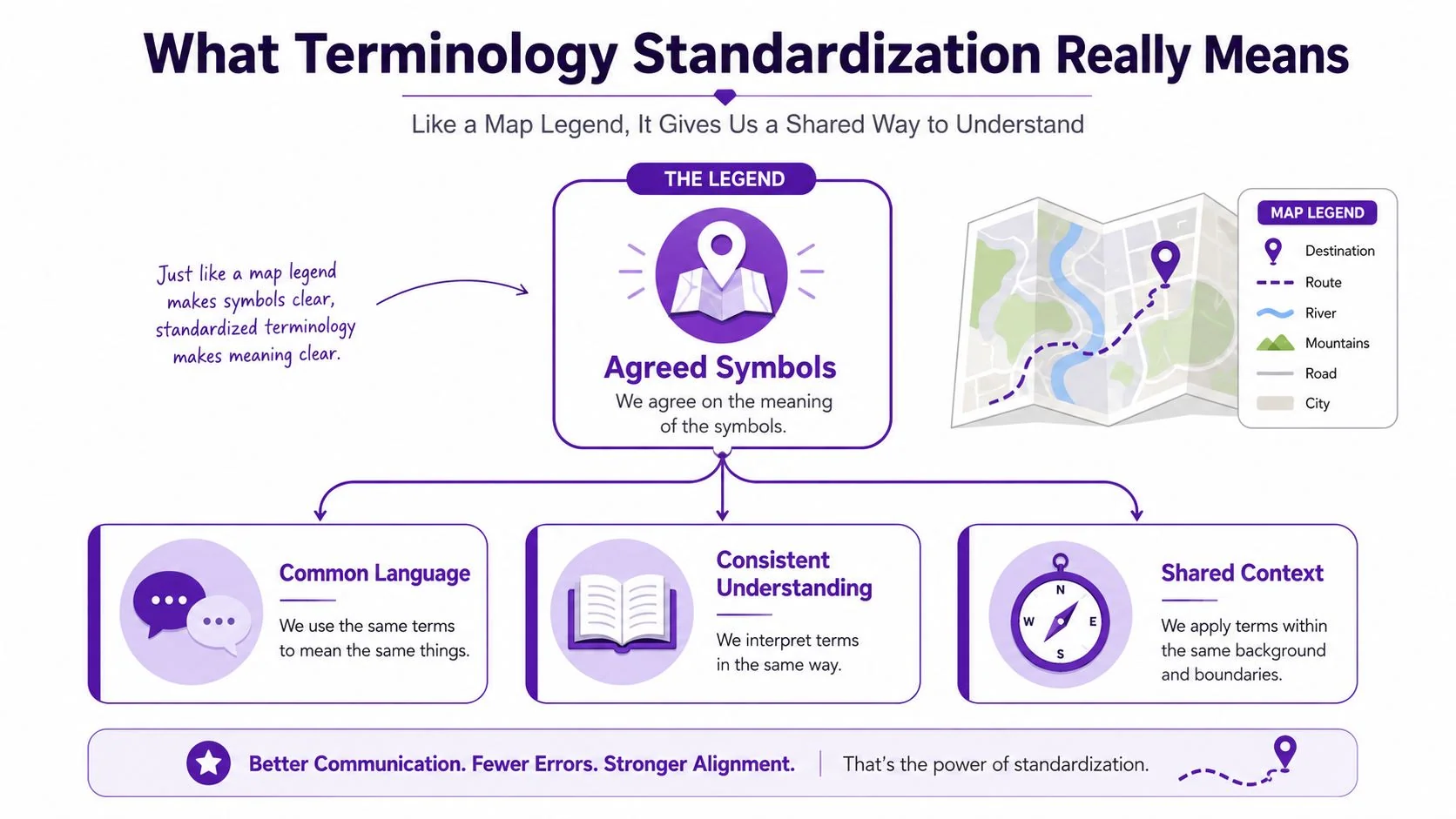
Think of a map legend. If one traveler reads the blue line as a river and another reads it as a highway, the map fails even if every symbol is neatly drawn. Terminology standardization works the same way, it gives everyone the same legend so they can interpret the terrain correctly.
That’s why this topic is bigger than spelling or preferred wording. A team can agree on a label and still fail if the label points to the wrong concept, or if different systems use the same word for different things. In practice, terminology work is about keeping the word, the concept, and the domain aligned.
ISO 1087 defines terminology work as the study and management of a domain’s terms and concepts, and it treats a terminology as a set of designations and concepts belonging to one subject domain (ISO 1087). That framing matters because it shows terminology standardization is a semantic mapping problem, not just a formatting exercise. You are not merely choosing prettier words. You are deciding which term points to which meaning, and where that meaning belongs.
Why the semantic part trips people up
Many teams start with a glossary and think the job is done. A glossary helps, but it can still leave synonyms, edge cases, and regional variants unresolved. Standardization asks harder questions, such as whether two different labels refer to the same concept, whether one label should be retired, and whether a term should change depending on audience or risk.
NIST’s definition of a standard makes this broader scope explicit, since it covers rules, conditions, and requirements for terms, classifications, procedures, dimensions, materials, and performance, not just naming (NIST IR 89-4194). That’s why terminology standards often sit beside other operating rules, not above them.
A term standard becomes useful only when people can apply it the same way in documents, systems, and conversations.
That’s also why teams should treat standardization as a shared interpretation layer. If your product, support portal, and analytics pipeline all refer to the same concept differently, users experience the organization as fragmented even when each individual team thinks it is being precise.
Business Impact and Governance Models
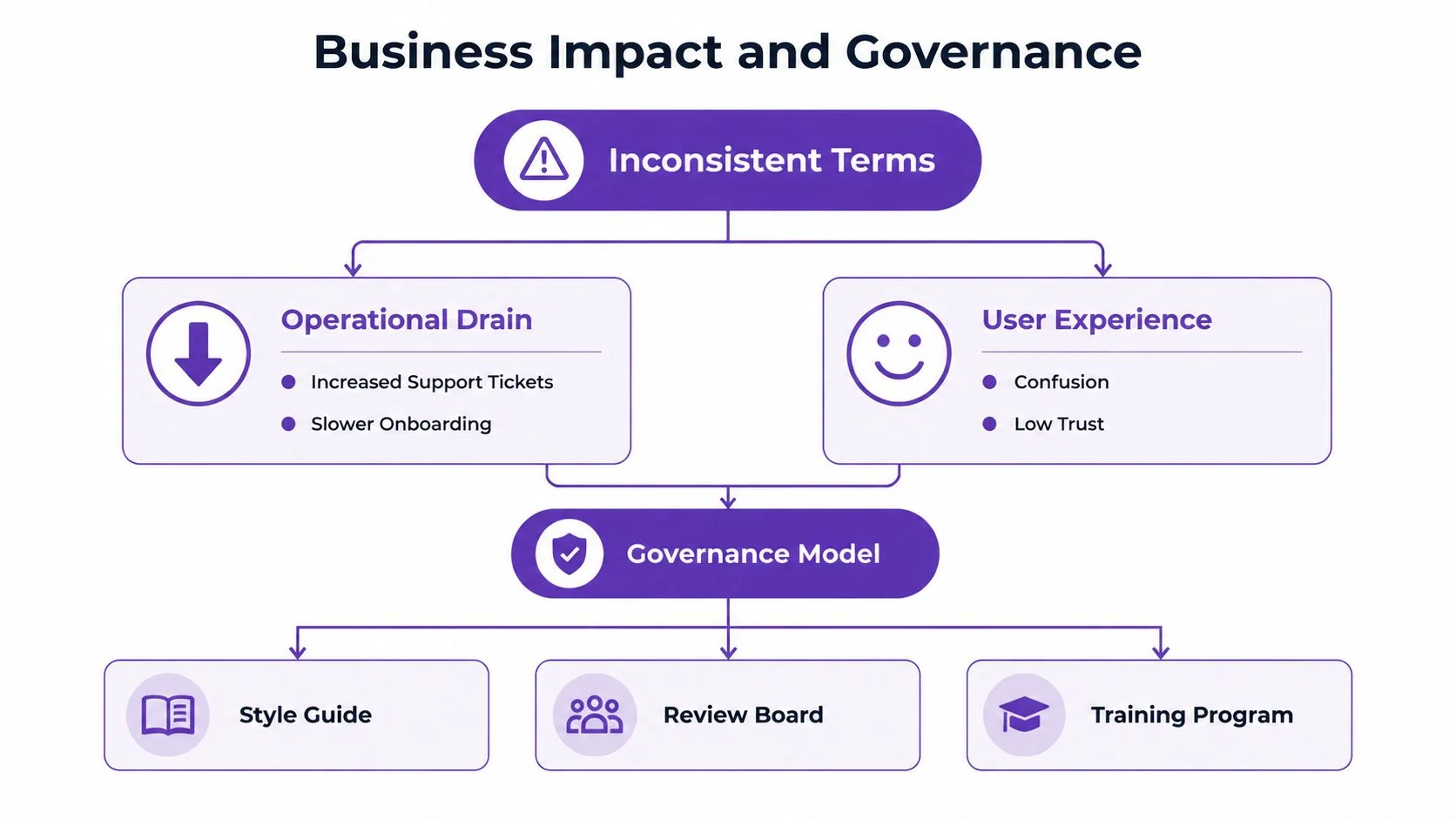
Inconsistent terminology usually shows up first as friction. Support agents ask follow-up questions because the customer used a different term than the knowledge base. Sales explains a feature one way, but the onboarding flow names it another way. The result is not only confusion, it’s avoidable rework.
The business side often sees the cost in operational drain and user experience. The support queue gets noisier because agents spend more time translating language than solving problems. Users lose trust when the interface, help docs, and email messaging don’t agree on what a feature is called.
Choosing a governance shape
Organizations usually land in one of two shapes. Some create a central terminology function that owns the standard and approves changes. Others use distributed ownership, where domain experts propose terms and a smaller review group keeps the system coherent. The right model depends on how regulated, cross-functional, and externally visible the language is.
Ireland’s guidance says a standard should be clinically relevant, meet a specific business need, be vendor neutral and backward compatible, financially viable, and supported by governance and processes (HIQA guidance). WHO also defines standardized terminology as terms with agreed definitions that link to a coding or classification system, which matters when the same term has to work in records, reports, and data exchange. That combination pushes teams to think beyond “which word sounds best” and into “which term can survive implementation.”
Who does what in practice
A workable governance model usually includes three roles. The terminology lead manages the inventory and keeps decisions traceable. Subject-matter experts review edge cases and confirm meaning. Executives or process owners back the policy when teams need to stop using a popular but conflicting label.
If you want a concrete example of the kind of operational clarity that benefits from standard naming, a well-structured SOP page can reduce ambiguity in recurring workflows, especially when the same process is executed by different teams, which is why many organizations tie terminology work to procedural documentation such as workflow and SOP documentation.
The point is simple. A terminology standard without governance is a document. A terminology standard with governance becomes a decision system.
Build a Terminology Standardization Framework
Start with a domain boundary. If the team tries to standardize every term in the company at once, the project turns abstract fast. A better move is to choose one domain, such as onboarding, billing, or support, and define the purpose, users, and risk points before writing anything down.
ISO 15188 is useful here because it tells teams to identify the purpose of the project, the potential users and their needs, situations where misunderstandings could create significant risk, and the legal and financial aspects during preparation (ISO 15188). That is a strong reminder that terminology work begins with context, not with vocabulary.
A practical sequence that holds up
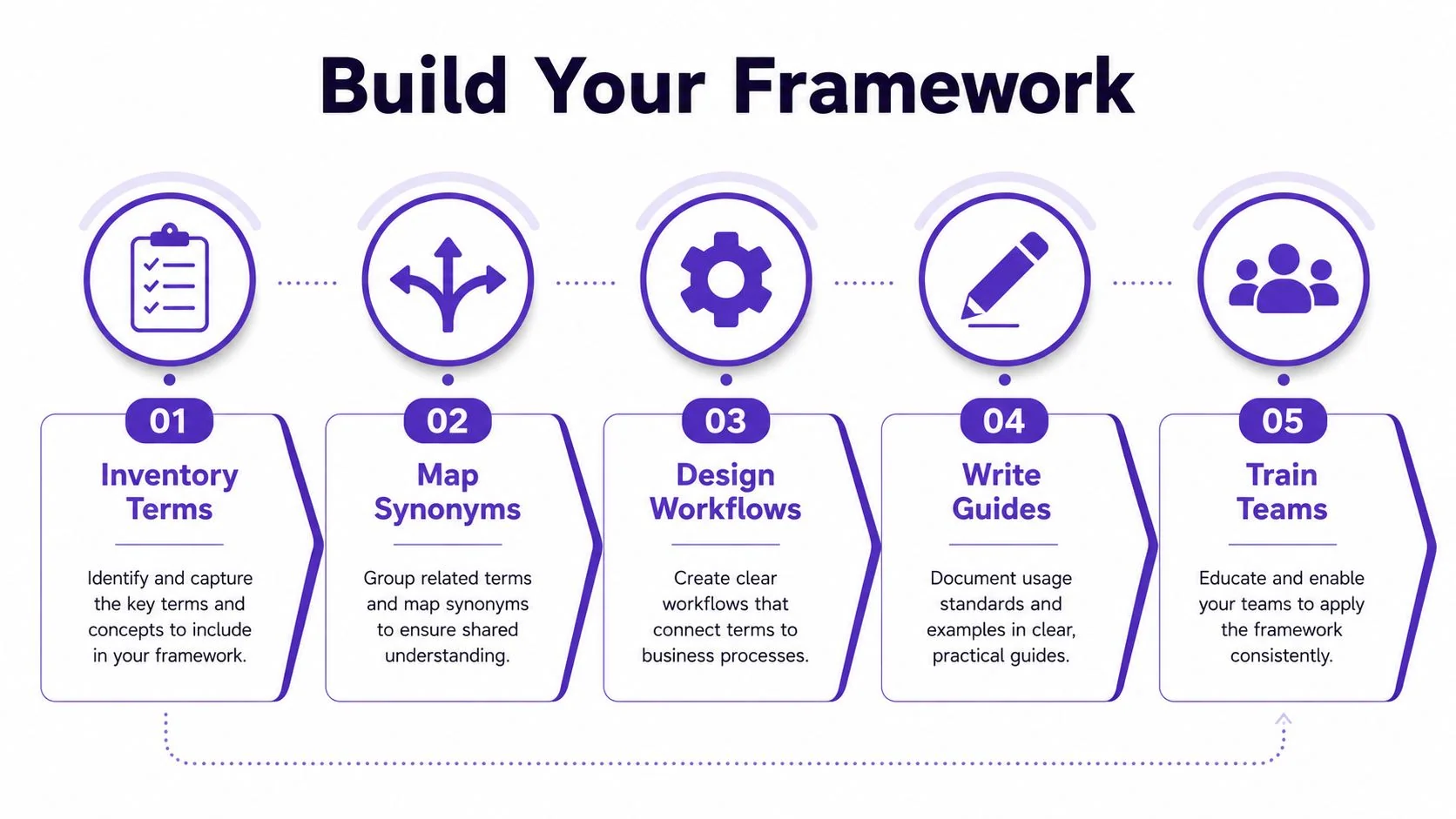
- Inventory existing terms. Pull the language from product UI, help content, support macros, sales decks, and training materials. You want the vocabulary people already use, not the vocabulary someone wishes they used.
- Map synonyms to one preferred concept. Teams must decide whether two labels mean the same thing or describe different things. The goal is not to erase nuance. The goal is to stop one concept from living under five names.
- Design approval workflows. Define who can propose a term, who reviews it, and who resolves disagreements. ISO 15188 also calls for acceptance criteria, responsibilities, time frames, and recorded decisions through periodic meetings, which is exactly the kind of structure that prevents standards from fading after launch.
- Write the style guide. Keep it specific. Note preferred terms, banned variants, definitions, context notes, and examples of correct usage. If a term is allowed in one context but not another, say so clearly.
- Train the people who will use it. Support, product, marketing, and documentation teams all need slightly different guidance. A standard survives when people know how to apply it in their own workflow.
Good terminology work is less about policing language and more about reducing the number of times teams have to renegotiate meaning.
Build for maintenance, not one-time cleanup
Use a review cadence that fits the domain. Fast-moving product language needs tighter checks than a stable regulatory glossary. Also document how changes happen, because the moment people can’t tell whether a term is current, deprecated, or under review, the standard starts losing authority.
If your organization also relies on knowledge bases, make sure the terminology policy is embedded in the article workflow. That keeps the same approved terms showing up in the places where users look for answers, which is why many teams connect terminology work with knowledge-base documentation workflows.
The framework only works when each step has an owner, a deadline, and a visible record of why a decision was made.
Tooling and Integration for Living Standards
A terminology standard that lives only in a PDF tends to fade. It works better when approved vocabulary shows up at the point of entry, the point of editing, and the point of publication. DataONE best practices recommends lookup tables, database field constraints, XML validation, and manual review to reinforce accepted vocabulary, because consistent referenced terminology and access-method metadata improve discovery and reuse across systems.
That matters because the standard has the best chance of surviving when people meet it before they drift. A content manager choosing from a picklist has less room to improvise. A documentation tool that validates fields or flags forbidden terms reduces the work reviewers have to do later.
Where standards usually belong
Start with the systems that create customer-facing language. CMS platforms, CRM records, help-center tools, release-note workflows, and internal wikis all benefit from controlled vocabulary. Product documentation pipelines need the same discipline, because a term approved in one place should appear the same way in screenshots, captions, and support articles.
The standard has to fit the workflow instead of relying on memory. Lookup tables help when people keep selecting from the same set of terms. Field constraints help at data entry. Validation rules help with structured exports. Manual review catches the cases automation misses, especially when meaning depends on context rather than format.
Using documentation tools to reinforce the standard
Teams also need a fast way to publish the guidance that explains the terminology. A screen recording plus narration can become a product demo, a help article, or an onboarding walkthrough if the team can generate both formats from the same source. That lets one recording support the rollout of the standard across multiple channels, instead of forcing the team to recreate the same explanation twice.
The best tool stack doesn’t replace terminology governance, it makes the approved language harder to ignore.
A well-integrated stack also protects the standard from version drift. If the content team updates a term in the CMS, the same change should flow into training material, knowledge-base articles, and internal support notes. Many teams also connect terminology work with knowledge-base documentation workflows, so the same approved terms appear where users look for answers. That reduces the chance that one outdated guide keeps a bad label alive for months.

Industry Examples and Common Pitfalls
Large organizations rarely standardize language because it sounds elegant. They do it because the cost of ambiguity shows up everywhere. Enterprises such as Bosch, Deutsche Bahn, Intesa Sanpaolo, Microsoft, and UNICEF operate in environments where people, regions, and teams need shared language to keep documentation usable and processes consistent.
The lesson is not that one vocabulary should flatten every local nuance. It’s that the organization needs a common core. The core gives teams a stable reference point, while local teams still adapt phrasing when the audience or service context demands it.
The subtle pitfall of vague labels
The most common mistake is over-generic language. A term like “underserved” can seem useful because it sounds broad and inclusive, but CDC and AMA guidance says it should be used more precisely, because it is reserved for limited access to services and should not be treated as a blanket synonym for poverty, race, or vulnerability (CDC preferred terms). CDC also recommends asking communities what they prefer and using service-specific language, such as “people who are underserved by [specific service/resource].”
That guidance matters beyond public health. Standardization can become harmful if it erases self-description, local identity, or context-specific meaning. A term may be technically tidy and still be the wrong choice for a community, a region, or a regulated setting.
What strong teams do differently
They treat standards as living agreements. They revisit labels when the audience changes, when a term becomes contested, or when a new system needs a more precise mapping. They also know that the goal is not uniformity for its own sake. The goal is shared understanding with enough flexibility to keep meaning accurate.
You can think of it this way. A useful standard is specific enough to support data quality and broad enough to survive across teams. If it becomes too rigid, people work around it. If it becomes too loose, it stops being a standard at all.
That balance is why terminology leaders spend so much time on exception handling. The edge cases are where governance either proves itself or falls apart.
Making Terminology Standardization Stick
The organizations that keep terminology clean don’t treat it as a one-time cleanup project. They treat it as a maintained system. The standard starts with one domain, gets approved through governance, gets enforced in tools, and gets reviewed as language changes.
That sequence matters because each layer depends on the one before it. Without a clear concept map, teams argue over words. Without governance, they argue over exceptions. Without tooling, people drift back to old habits. Without maintenance, the standard becomes stale and loses trust.
The most practical first move is to inventory one domain and separate preferred terms from everything else. That gives you a visible baseline and exposes where the terminology is already doing hidden work. Once that baseline exists, the organization can decide which terms need stronger rules, which ones need training, and which ones need local variation.
A standard sticks when people can find it, apply it, and trust that it will still be there next quarter.
If your team is trying to turn expert knowledge into clear tutorials, documentation, and onboarding material, Tutorial AI can help you capture a single recording and turn it into a polished tutorial video plus a matching article. Visit Tutorial AI to see how one workflow can support cleaner rollout, faster updates, and more consistent knowledge sharing.