A product team publishes a feature walkthrough in English, then asks the localization team to “make it global.” The request sounds simple until someone discovers that the video has burned-in interface labels, the help article uses unreleased terminology, the sales deck contains market-specific claims, and the captions run longer than the original scenes. By launch day, every team is working from a different version of the truth.
That failure starts before translation. Multilingual content strategy is a market-selection and discovery discipline first, then a production system. You need to decide which audiences deserve investment, which assets require cultural adaptation, and how video, documentation, training, and search content will stay aligned after release.
Why English-First Content Leaves the Largest Markets on the Table
A mid-stage SaaS company may launch product updates, help articles, and demo videos in English while support requests from Brazil, Germany, and Japan sit in a spreadsheet. Paid acquisition continues in those regions, yet prospects still evaluate the product through an English-only experience.
Teams usually patch the gap one asset at a time. A support manager translates a troubleshooting article, a regional salesperson rewrites a slide, and a marketer commissions subtitles for a launch video. Those fixes solve an immediate need but create no shared system. Terminology then diverges across Docs, Training, Sales, and Product Marketing.
English dominates published web content. It represented 49.4% of global web content in February 2025, compared with 6.0% for Spanish and 5.6% for German, according to Statista’s data on languages used on the internet. Use that figure to understand publishing supply, not to estimate audience demand. A large English inventory does not prove that English is the best language for every buyer.
Audience scale and language concentration are different problems
By October 2024, the internet had 5.52 billion users worldwide. Those users include language communities across China, Spain, Latin America, Germany, and multilingual regions in Europe, Africa, and Asia. English-only publishing therefore limits discovery, product education, onboarding, and support, even when the underlying product can serve those markets.
Historical data show the same shift. A 2020 snapshot estimated 1.186 billion English internet users, or 25.9% of global internet users, followed by 888.5 million Chinese users, 363.7 million Spanish users, and 237.4 million Arabic users. The historical overview of internet language distribution records native English speakers declining from about 80% of internet users in 1993 to 29.7% by 2006. Language diversification is a long-term market condition, not a temporary localization trend.
Start discovery with evidence. Compare support volume, search behavior, trial and demo activity, sales objections, and expansion potential by region. Then map the minimum content set for each selected audience: a product walkthrough, training materials, documentation, and the support paths that remove adoption barriers. Tutorial AI can support video production inside that stack, but it cannot decide which market deserves investment or whether a translated asset is commercially complete.
Practical rule: Treat non-English demand as a routing problem. If prospects search, evaluate, onboard, and request support in another language, route them to a complete experience.
Choose markets deliberately, match adaptation effort to commercial intent, and build production controls before every launch becomes a rescue project.
What a Multilingual Content Strategy Actually Means
A multilingual content strategy determines which markets you serve, which languages you support, what content you adapt, and how often you refresh it. Translation is only one production step inside that decision system.
Start by separating four activities that SaaS teams frequently bundle together:
- Translation converts source language into target language while preserving meaning. A product error message, API reference, or evergreen help article usually needs faithful rendering and stable terminology.
- Localization adapts the experience to a specific market. A German help article may use formal Sie, adjust examples, and reflect local search phrasing rather than mechanically reproducing the English page.
- Transcreation rebuilds the creative idea for emotional and commercial impact. A Japanese product launch video might use different scenarios, pacing, and proof points instead of preserving every scene from the English version.
- Strategy decides which of those treatments is justified, for which audience, and at what point in the buyer journey.
That last layer is where most programs fail. A team may localize a homepage while leaving the onboarding video, product UI links, and support article in English. The visitor gets a localized promise but an English execution. The result feels incomplete, even when every translated sentence is technically correct.
Build around market intent, not source-language volume
Your strategy should connect local keyword research, regional buyer needs, content formats, distribution channels, and operational capacity. Search intent changes by language and region, so translating an English keyword list can produce content that reads well but fails to match what people search for. Technical SEO foundations, including language-specific URLs, metadata, and hreflang implementation, also need to support the content rather than sit outside the workflow.
For a deeper treatment of international search planning, use this guide to global SEO strategies as a companion resource. The important operating principle is simple: select the market before selecting the translation method.
Make the source content reusable
The strongest source assets are modular. A single narrated product recording can become a polished tutorial video, captions, a transcript, screenshots, and a structured help article. That reuse matters because every additional format creates another localization surface.
Map content by job:
- Discovery: localized landing pages, comparison pages, and search articles.
- Evaluation: demos, feature release videos, case materials, and sales enablement.
- Adoption: onboarding, help-center videos, and implementation guides.
- Retention: support articles, training refreshes, and release documentation.
This framework stops localization from becoming a language queue. It turns it into a portfolio decision, where teams invest in the assets most likely to remove market friction.
Translation, Localization, and Transcreation Compared
The right treatment depends on the asset’s purpose. A CLI flag shouldn’t receive the same creative investment as a campaign headline, and a brand campaign shouldn’t be pushed through a literal translation workflow just because the source file is ready.
| Dimension | Translation | Localization | Transcreation |
|---|---|---|---|
| Source of truth | Meaning and terminology in the source text | Meaning plus local conventions, intent, and user expectations | Business idea, audience emotion, and campaign objective |
| Cost multiplier | Lowest of the three when the source is clear | Higher because reviewers adapt context and market details | Highest because the concept may need new copy, visuals, and scenarios |
| Typical turnaround | Fast for stable, repetitive content | Moderate, with in-context review | Longer, because creative development and approval are iterative |
| Ideal asset type | Reference documentation, UI strings, evergreen support content | Help-center pages, landing pages, emails, onboarding, product education | Hero campaigns, launch moments, paid creative, taglines |
| Risk if misapplied | Accurate words that still sound unnatural or miss search intent | A locally fluent asset that over-invests in low-value content | Wasted budget, reviewer fatigue, and inconsistent product terminology |
Use a decision rule tied to risk
Choose translation when accuracy and retrieval matter more than persuasion. An API reference, a setup checklist, or a stable support article should preserve the source meaning, product names, and approved terms. That doesn’t mean skipping review. It means keeping the review focused on clarity, terminology, and functional accuracy.
Choose localization for assets that influence behavior. A landing page needs local search language, familiar calls to action, appropriate examples, and market-specific proof. An onboarding video may need altered on-screen text, captions, pacing, and voiceover while keeping the product flow intact.
Reserve transcreation for content where the concept carries the conversion burden. A campaign built around wordplay, cultural references, or an emotional promise may need a local creative brief rather than a translation brief. The reviewer should approve the idea against the market objective, not compare every sentence against the English source.
Editorial rule: Don’t ask translators to solve a strategy problem. Give them the asset’s job, audience, market, approved terminology, and acceptable degree of creative freedom.
Your planning document should record the treatment before production starts. For each asset, name the source owner, market owner, risk level, expected reuse, and QA owner. Teams that make this choice upstream avoid two expensive mistakes: under-localizing persuasive content and over-processing low-risk reference material.
For implementation details that connect these choices to product content, see Tutorial AI’s localization best practices. Use the resource to strengthen the handoff between content planning and execution, not as a substitute for market judgment.
Picking Languages and Audiences Before You Pick Tools
A language vendor can offer capacity without offering a viable market. Choose languages from evidence: use web-language distribution as a directional signal, then test it against commercial, product, and audience data.
Historical internet-language data places English, Chinese, Spanish, and Arabic among the largest language groups online. Use that pattern as context, not as a market forecast. It shows why an English-first plan leaves demand undiscovered, but it cannot tell you which locale to launch next.
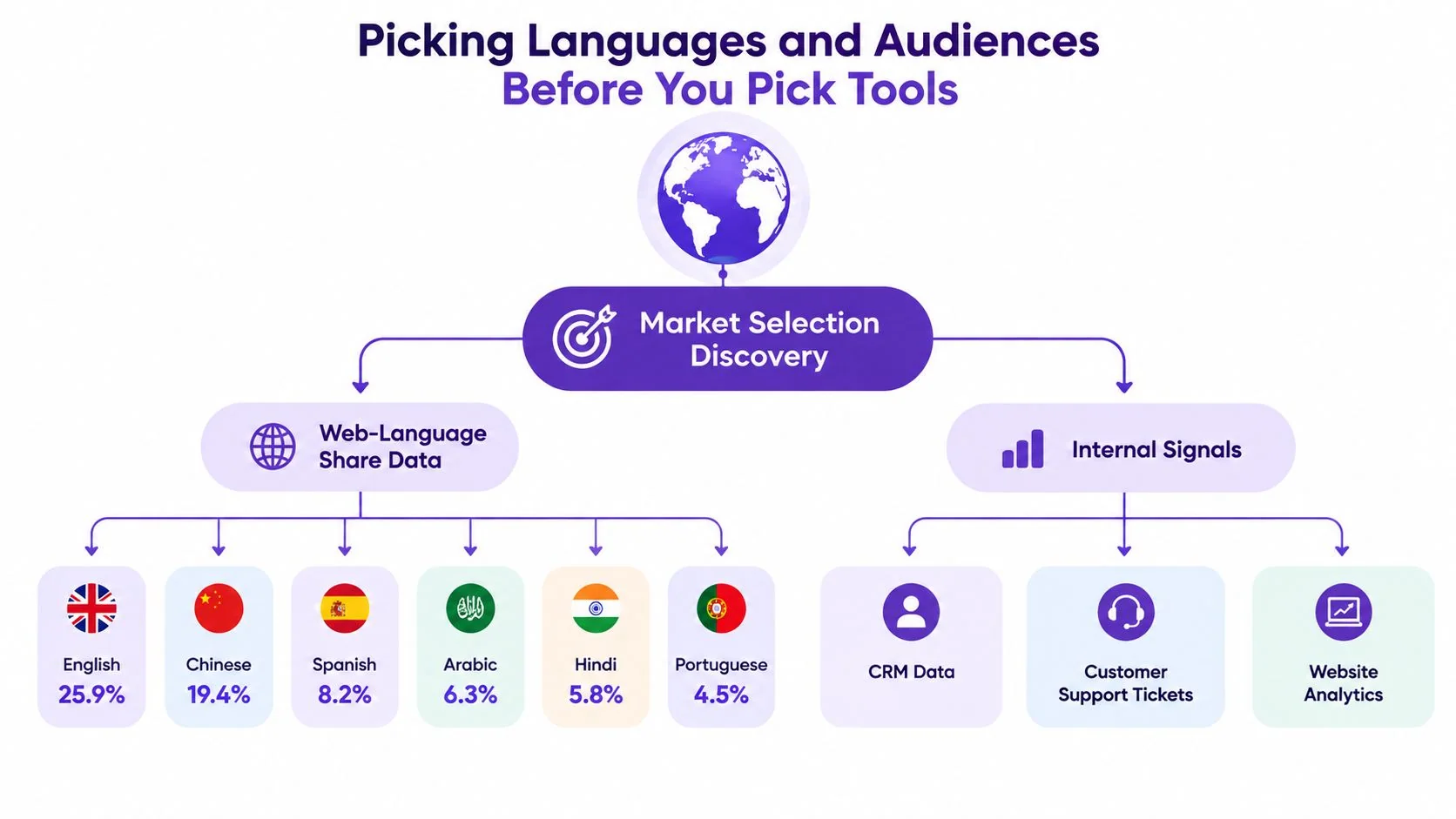
Score markets using converging signals
Build a candidate scorecard across four commercial dimensions:
- Demand intensity: CRM country data, organic search impressions, demo requests, product usage, and support volume.
- Deal value: pipeline quality, expansion potential, retention importance, and strategic account concentration.
- Competitive gap: whether competitors provide usable local content, localized onboarding, and in-language support.
- Localization cost: language complexity, reviewer availability, legal requirements, video adaptation, and maintenance work.
Add audience behavior to the score. A market with limited web visibility may still outrank a larger language if product usage repeats and sales opportunities carry higher value. An international SEO agency Brussels can support regional search research, but your internal evidence must decide whether search demand connects to revenue.
Use launch tiers and an asset audit
Set three operating tiers:
- Launch: full localization, local search research, and transcreation for hero assets.
- Pilot: MTPE, subtitling, selected help content, and a human review loop.
- Watchlist: monitor demand and competitor activity without opening a full locale.
Audit the assets before assigning work. Map product demos, feature release videos, customer onboarding, help-center videos, support articles, internal training, SOPs, and sales walkthroughs to the buyer journey. Rank each by traffic, business value, freshness, and reuse potential.
For video and training, start with assets that explain product value or reduce support load. Tutorial AI can fit the production stack for creating or adapting tutorial content, but it does not choose the market, approve terminology, or replace local review.
Ship a Tier 1 locale only when at least three internal or external signals converge. Translation capacity is an execution input, not a market-selection argument. Open the locale when demand, commercial value, and an operating model support the investment.
The Localization Workflow That Scales Beyond One Team
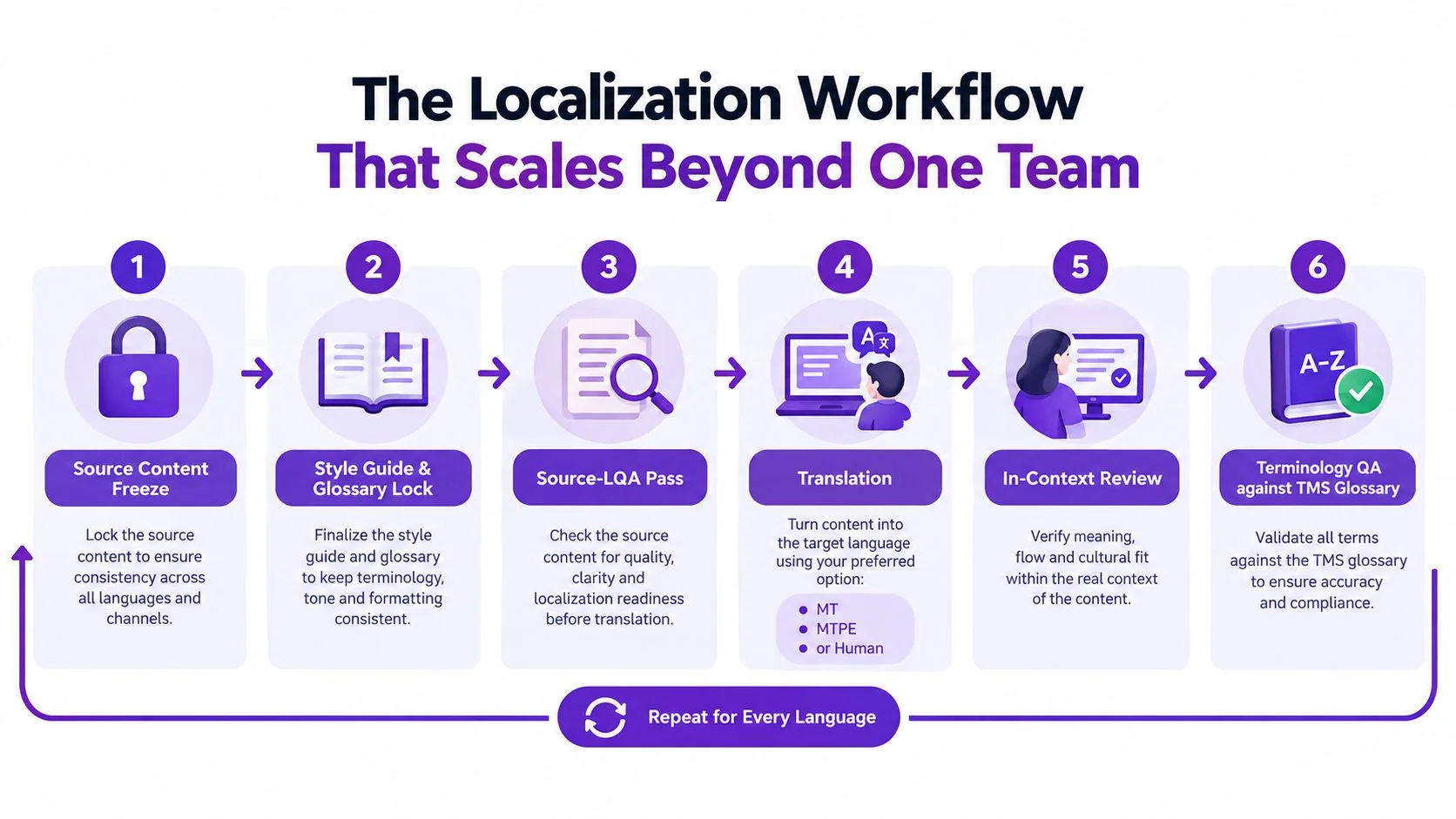
A scalable workflow begins with source discipline. If Product Marketing changes the feature name after translation starts, every downstream asset becomes a correction project. Freeze the source, publish the approved terminology, and make ownership visible before anyone requests language work.
Build the pipeline around controlled handoffs
Use this sequence:
- Source content freeze: lock the script, article, interface labels, screenshots, and release context.
- Style guide and glossary lock: define tone, forbidden terms, approved product names, formality, and market exceptions.
- Source-LQA pass: remove ambiguity, fix inconsistent labels, and confirm that the source can be translated without guesswork.
- Translation: choose machine translation, MTPE, or human translation according to asset risk.
- In-context review: review the content inside the CMS, LMS, player, or product flow.
- Terminology QA against the TMS glossary: check approved and forbidden terms before release.
- Linguistic QA: use a second-pass reviewer for fluency, meaning, tone, and omissions.
- Functional QA and publish: test links, layouts, captions, audio, screenshots, and responsive behavior in the rendered destination.
A TMS should hold translation memory, termbases, workflow status, and reviewer assignments. CAT tools support linguist editing, while CMS and LMS connectors keep source updates from being copied manually into separate language files. For video, the localization stack needs transcription, translation, caption handling, voiceover, and re-timing.
Terminology management deserves its own control because it reduces ambiguity for translators, reviewers, subject-matter experts, and machine-translation systems. RWS’s terminology management guidance describes how approved and forbidden terms preserve context and integrate with CAT, MT, and TMS workflows.
Set three non-negotiable QA gates
- Terminology gate: every controlled product term matches the approved glossary, and forbidden variants have an owner-approved exception.
- Linguistic gate: a reviewer confirms meaning, grammar, tone, omissions, and cultural suitability in context.
- Functional gate: the rendered asset works. Buttons, links, layouts, captions, voiceover timing, screenshots, and LMS behavior must pass.
Industry guidance recommends measuring terminology consistency and gating releases with terminology-compliance QA. Some localization programs target above 95% core-term accuracy, as summarized by Gleef’s multilingual content management guidance. Use that as a governance target only where your glossary is mature enough to support reliable measurement.
Automation accelerates repetitive work, but it doesn’t replace judgment. Auto-redubbing and automated timing can work well for a product UI walkthrough with a stable script. Thought-leadership video, humor, sensitive customer stories, and culturally loaded examples need human adaptation. For teams localizing tutorial videos, AI video dubbing workflow guidance can inform tool evaluation.
Close every job with handoff artifacts: final source script, glossary changes, approved translations, caption files, voiceover files, screenshots, reviewer notes, and release version. Docs, Training, and Sales should consume the same approved strings, not recreate them from memory.
Role-Based Playbooks for Docs, Training, and Sales
Different teams need different localization controls because their assets fail in different ways. Documentation fails when terminology drifts or releases fall out of sync. Training fails when captions, narration, on-screen text, and assessments disagree. Sales content fails when a fluent translation still sounds irrelevant to a regional buyer.
Give every function a clear operating brief
| Function | Priority assets | Approach | Tooling | QA owner |
|---|---|---|---|---|
| Documentation | Help articles, support videos, setup guides | MTPE for reference content, human review for high-traffic workflows | CMS connector, TMS, glossary, documentation generator | Technical writer and locale reviewer |
| Training | Courses, onboarding videos, captions, assessments | Localize the full learning object, not only the transcript | LMS, subtitle workflow, dubbed audio, timing tools | Learning designer and regional reviewer |
| Sales | One-pagers, battlecards, ROI calculators, demo walkthroughs | Transcreation for persuasion, controlled translation for product facts | CRM or asset library, approved claims repository | Sales enablement and market owner |
Documentation teams should identify their most-used help articles, link them from the product UI, and keep versioned source files tied to releases. A video that demonstrates a setting should generate the companion article from the same approved recording or script, so the screenshots and wording don’t diverge. Guidance on technical documentation translation is useful when defining that source-to-article workflow.
Training owners need to treat a course as a bundle of synchronized assets. That includes subtitles, dubbed voice, on-screen text, transcripts, quizzes, downloadable references, and accessibility outputs. A 2023 study concluded that subtitles can improve accessibility, comprehension, adaptability, inclusion, and memory retention for higher-education viewers, as documented in this study of educational subtitling. The same principle applies to customer onboarding and internal training.
Sales enablement needs stricter commercial governance. Localize the story, not the product facts. Pre-approve claims, competitor references, customer names, and numerical statements for each market, then let local teams adapt examples and buyer language within those boundaries.
Each function should own a compact launch checklist:
- Docs: source version, glossary status, screenshots, links, article reviewer, release date.
- Training: captions, narration, on-screen copy, assessments, accessibility review, LMS tracking.
- Sales: approved claims, local proof, battlecard review, calculator assumptions, field feedback.
Tutorial AI fits the production layer when a subject-matter expert can narrate a screen recording and needs both a polished tutorial and a written article from the same source. Its documented workflow includes editable narration, multilingual voiceover, captions, automatic scene timing, and article generation. It supports formats such as product demos, customer onboarding, SOPs, sales walkthroughs, and help-center videos, but market owners still need to decide whether the message requires localization or transcreation.
Measurement, QA, and When to Retire a Market
A multilingual program needs three measurement layers. Content health tells you whether the pipeline is operating. Localization quality tells you whether the experience is trustworthy. Business outcomes tell you whether the market deserves continued investment.
Track content health with terminology consistency audits, machine-translation quality estimation scores, reviewer dispute rates, translation rework, source-change frequency, and time to publish by locale. Track localization quality through linguistic QA findings, in-product terminology checks, regional customer feedback, and NPS by region. For business outcomes, use localized search impressions, click-through rate, qualified pipeline, conversion, support-ticket deflection, and active usage in the target language.
Use a dashboard that exposes trade-offs
| Category | Example KPIs | Owner | Cadence |
|---|---|---|---|
| Content health | Terminology consistency, source-change rate, time to publish, rework volume | Localization operations | Weekly |
| Localization quality | QA defects, reviewer disputes, glossary compliance, regional feedback | Locale owner | Per release and monthly |
| Search discovery | Impressions, CTR, indexed pages, local query coverage | SEO lead | Monthly |
| Customer experience | NPS by region, support-ticket deflection, onboarding completion | Support and Customer Success | Monthly |
| Commercial outcome | Qualified pipeline, conversion, expansion signals, cost per active user | Revenue and market owner | Monthly and quarterly |
| Governance | Open escalations, overdue reviews, refresh debt, RACI exceptions | Program lead | Quarterly |
Don’t hide quality behind a single score. A locale can publish quickly while accumulating terminology errors, or generate traffic while failing to support activation. Review the dashboard by asset type and buyer journey stage so a weak onboarding video doesn’t disappear inside a healthy overall average.
Define the ship, re-scope, or retire decision
Use a market review rule based on cost per active user, content refresh debt, and pipeline conversion:
- Ship: demand and pipeline justify the current content surface, quality gates pass, and the team can maintain source updates.
- Re-scope: the market shows credible demand but the current asset mix is too broad. Keep high-value landing pages, onboarding, and support paths. Pause low-reuse content.
- Retire: usage remains weak, refresh debt keeps growing, and pipeline conversion doesn’t justify the localization burden.
A stalled Portuguese-BR program shouldn’t automatically be abandoned. Re-scope it around the pages generating qualified demand, the support workflows producing repeated friction, and the product paths where language affects activation. If those focused assets still fail to produce evidence of value after a defined review cycle, retire the locale deliberately and document the decision.
Governance makes this possible. Assign a Responsible locale owner for daily quality, an Accountable market leader for investment, Consulted Product, Support, SEO, and Legal partners, and Informed Sales and Training teams. Hold a quarterly business review with the scorecard, top defects, terminology changes, pipeline movement, refresh debt, and the next market decision.
Compliance also belongs in governance, especially when localization tools process customer or employee data. SOC 2 and GDPR are distinct, and SOC 2 doesn’t make an organization GDPR-compliant. This comparison of SOC 2 and GDPR explains that GDPR covers matters such as lawful basis, data-subject rights, DPIAs, records of processing, DPO obligations, and international transfers, which SOC 2 doesn’t address as a legal framework.
Governance rule: When quality slips, escalate the asset and the cause separately. Fix the translation, then fix the missing glossary rule, unclear source, weak reviewer assignment, or broken connector that allowed the defect through.
Tutorial AI helps teams turn one narrated screen recording into a polished tutorial video and a matching written article, then prepare localized narration, captions, and timing for multilingual delivery. Visit Tutorial AI to see how that source-to-video-to-documentation workflow can fit into your Docs, Training, or Sales content stack.