A deal rarely falls apart because the product is bad. It usually stalls because the buyer can’t connect the product to their environment, their workflow, or their risk tolerance.
That’s the moment the sales engineer steps in.
If you’re reading this, you’re probably in one of three situations. You’re considering the role, hiring for it, or already doing parts of it without the title. In each case, the sales engineer job profile looks deceptively simple from the outside. People say it’s “technical presales” and move on. That description misses the point.
A good sales engineer is the person who keeps a technical sale honest. They make sure the account executive doesn’t promise something the product can’t deliver. They help the customer see the path from demo to rollout. They hear the hidden objection behind the polite question. And when the room splits between technical evaluators, business sponsors, security reviewers, and end users, they translate across all of them without losing credibility with any of them.
That’s why strong sales engineers become central to revenue teams. They’re not sidekicks. They are the technical conscience of the sales process, and in complex software sales, they often determine whether a deal moves forward at all.
The Unseen Force Behind Tech Sales
A familiar scene plays out in enterprise sales. The account executive has built momentum. The buyer likes the vision. Procurement is warming up. Then the technical review starts, and the energy changes.
The customer asks questions that expose the gap between a polished pitch and a real deployment. How will this connect to the LMS? What happens to existing content workflows? Who owns setup? What breaks if their team needs governance, versioning, or multilingual delivery? The room gets quiet because these aren’t “nice to have” questions. They decide whether the buyer sees momentum or risk.
That’s where the sales engineer earns trust.

The sales engineer job profile is best understood through these moments. The role isn’t just about knowing the product. It’s about diagnosing the buyer’s environment, narrowing ambiguity, and turning technical uncertainty into a concrete plan. A weak SE gives a feature tour. A strong one makes the buyer feel that implementation is manageable and the outcome is worth it.
I’ve seen new hires underestimate this part of the job. They assume the role is mostly demos and occasional objection handling. In practice, the SE often carries the burden of proof. The buyer may like the salesperson, but they believe the technical person who can explain trade-offs without sounding evasive.
Practical rule: If the buyer leaves your meeting with fewer unknowns and more confidence, you did your job. If they leave with more excitement but the same confusion, you didn’t.
That’s why this role matters so much in software companies. Revenue doesn’t come from excitement alone. It comes from confidence, clarity, and technical credibility delivered at the right moment.
What Does a Sales Engineer Actually Do
A sales engineer turns technical uncertainty into buying confidence.
That sounds simple until the deal gets real. The prospect wants to know whether your product will fit their stack, satisfy security, support the workflow their team already uses, and get deployed without creating a mess for IT. The SE owns that conversation. In practice, the role sits between product and revenue. A good SE does not just explain how the software works. They show why it will work for this specific customer, under these constraints, with a realistic path to value.
They lead technical discovery that changes the sales strategy
Strong SEs start by finding the risks that could kill the deal later.
They ask about current systems, data flows, identity setup, approvals, compliance needs, rollout owners, and success metrics. Then they push one level deeper. If the buyer uses a legacy LMS, what does that mean for integrations? If multiple departments own content, who approves changes? If security review takes six weeks, what has to happen before the champion can get internal support?
New SEs often collect answers and stop there. Experienced SEs connect those answers to consequences. Discovery should change how the account team sells, what gets demoed, how the solution is scoped, and whether the opportunity is worth pursuing at all.
They shape the solution before the customer says yes
This part gets missed in weak job descriptions.
Sales engineers help define the version of the product the customer can purchase and implement. That can include mapping requirements, identifying dependencies, flagging gaps, proposing workarounds, sketching architecture, and setting honest expectations about rollout effort. The work is part technical design and part risk management.
In many teams, this is also where the SE influences deal quality. If the proposed solution is too broad, the customer gets excited and the delivery team inherits a problem. If the scope is too narrow, the customer does not see enough value to move forward. Good SEs find the middle ground. They make the path believable.
They make the commercial team sharper
An SE partners with account executives, SDRs, customer success, implementation, support, and product marketing. The role is collaborative, but it should never be passive.
A capable SE usually does five things consistently:
- Qualifies technical fit early: They identify integration blockers, unsupported use cases, and unrealistic expectations before the team burns cycles.
- Handles objections with specificity: They explain what the product supports today, where configuration solves the issue, and where a limitation is real.
- Supports evaluations and technical reviews: They answer security questions, complete technical questionnaires, and help the buyer build internal confidence.
- Defines proof-of-concept scope: They keep the team focused on proving the outcome that matters, instead of turning a POC into free consulting.
- Protects the handoff: They document commitments, assumptions, and open questions so post-sale teams inherit facts, not wishful thinking.
That discipline is one reason strong SE teams improve overall sales enablement best practices. They do not just help close deals. They improve how the company qualifies, sells, and delivers.
They feed product and marketing with field truth
Sales engineers hear where deals stall.
They see the confusion points in live calls, the feature claims that need tighter wording, the integrations buyers ask about every week, and the demo moments that either create urgency or raise doubt. Salesforce notes in its overview of the sales engineer role that SEs are heavily involved in product demos. That exposure gives them a clear view of what buyers understand, what they mistrust, and what they need before they can say yes.
This feedback is valuable because marketing usually sees intent patterns and campaign performance. SEs see friction inside actual evaluations. Product teams need that input. Marketing teams need it too. If nobody captures it, the same objections keep showing up quarter after quarter.
They protect credibility, even when the answer is no
One of the hardest parts of the job is keeping a deal alive without saying yes to everything.
Some prospects ask for features they will never use. Others want aggressive timelines that depend on resources they do not have. Some want custom work that breaks the economics of the deal. A weak SE avoids tension in the moment and creates bigger problems later. A strong SE explains the trade-off clearly, offers a realistic option, and keeps trust intact.
That is the fundamental mission. The sales engineer is not there to add technical color to the pitch. The sales engineer is there to make the deal winnable, deliverable, and worth keeping after it closes.
The Essential Sales Engineer Skillset
The sales engineer job profile combines two skill families that have to work together. One is technical depth. The other is strategic communication. If either side is weak, the role breaks.
A highly technical SE who cannot guide a buying conversation becomes a product specialist. A polished presenter with shallow technical knowledge becomes a risk to the deal. The strongest SEs blend both.
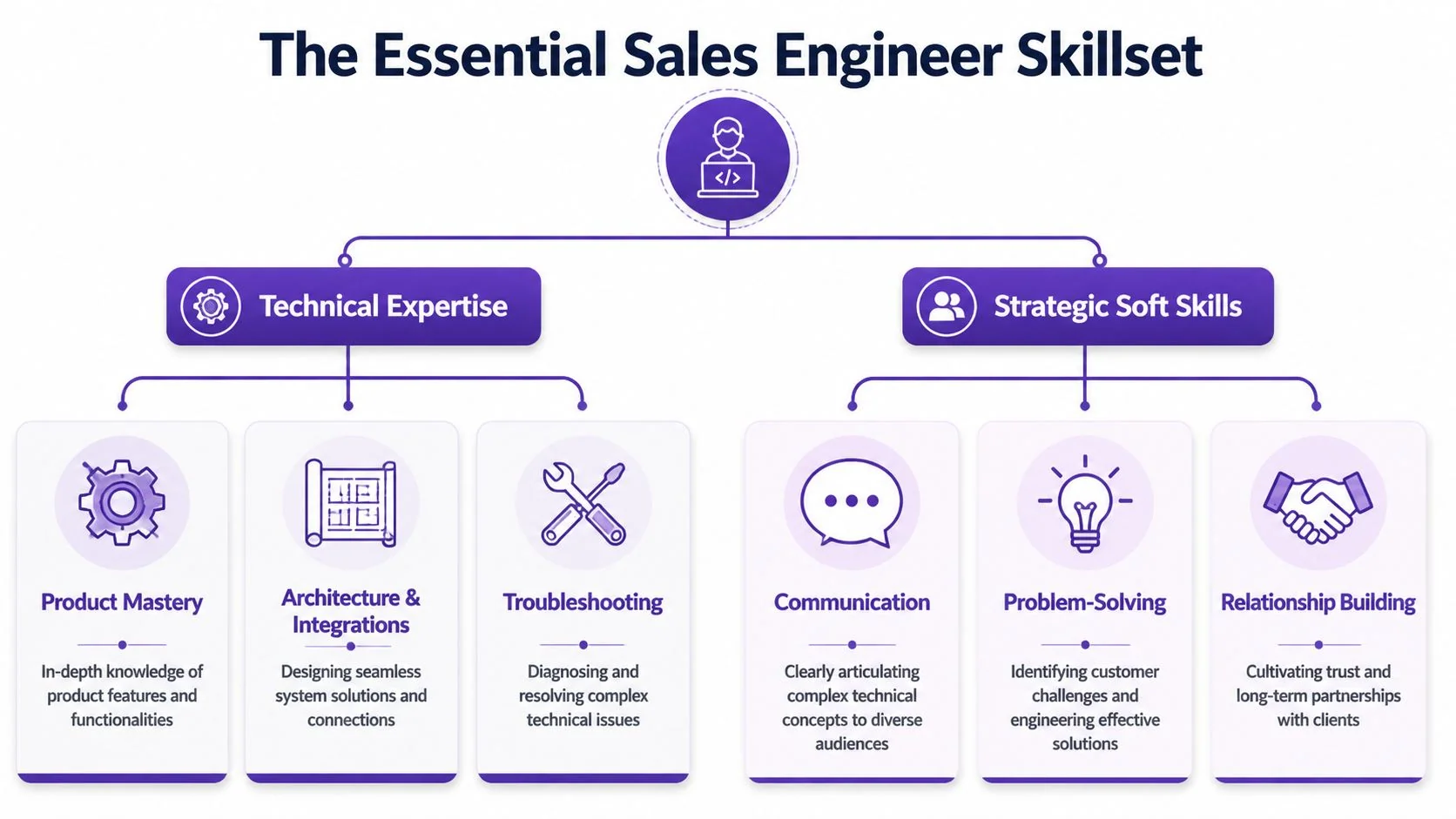
Technical expertise
This is the baseline. Without it, the customer will sense weakness quickly.
A strong SE needs more than surface-level feature knowledge. They need to understand how the product behaves inside real environments, where the limits are, and what dependencies matter during rollout.
Three technical capabilities tend to separate average SEs from trusted ones:
- Product mastery: You should know core workflows cold, but also edge cases, limitations, and configuration paths.
- Architecture and integrations: Buyers need to know how the solution fits with systems like LMS, CMS, CRM, identity tools, and documentation platforms.
- Troubleshooting under pressure: The best SEs recover from demo issues, data mismatches, and unexpected customer questions without losing the room.
This is also where domain knowledge matters. If you sell to customer education teams, support teams, or product marketers, your product knowledge has to connect to how those teams work. Generic technical fluency won’t carry you very far.
Strategic soft skills
Soft skills is too small a phrase for what’s really required here. This part of the role is commercial judgment.
You need to ask questions that uncover risk, not just gather requirements. You need to present to technical teams without sounding evasive and to executives without drowning them in detail. You need to know when to zoom in and when to simplify.
Here are the skills I coach hardest:
Communication that adapts to the room
An engineer may care about integration details. A department lead may care about rollout friction. A VP may care about adoption and risk. One demo script will not work for all three.
That’s why presentation quality in this role is less about polish and more about control. Can you explain the same capability three different ways without sounding inconsistent?
Problem framing
The customer often describes symptoms. Your job is to find the operational problem behind them.
If a team says their video tutorials take too long to create, the underlying issue may be review bottlenecks, editing dependency, inconsistent branding, or content that goes stale after each release. The SE who identifies the root cause will frame the solution better than the one who just maps features to requests.
Relationship building through candor
Customers trust the SE who is clear about trade-offs. They don’t need hype. They need a competent guide.
That means admitting when a use case needs validation, narrowing proof-of-concept scope, and setting expectations that the delivery team can honor. Trust comes from precision.
Where the two skill sets meet
Top technical sales engineers use data analysis and customer preference signals to build personalized ROI models. According to this technical sales engineer skills guide, that can drive a 25-35% uplift in average deal size, and in SaaS examples, tying product capability to operational efficiency can show how localization efforts decrease by 70%.
That’s the crossover point. Technical knowledge alone doesn’t create commercial impact. The SE has to connect a feature to an outcome the buyer values.
For teams trying to sharpen that connection, these sales enablement best practices are useful because they push the conversation beyond product knowledge into repeatable buyer-facing execution.
The best sales engineers don’t just answer technical questions. They help the customer justify the decision internally.
Skills that usually get ignored until they hurt you
New SEs often focus on product expertise and demo skills, which makes sense. But a few abilities become painful gaps later:
| Skill area | Why it matters in practice |
|---|---|
| Internal alignment | You need clean coordination with AEs, implementation, and product teams or the customer hears mixed messages |
| Note quality | Bad notes create bad proposals, bad handoffs, and avoidable churn |
| Prioritization | Not every deal deserves custom work |
| Competitive judgment | You don’t need fear-based selling, but you do need to know where your product wins cleanly |
If you want a simple test of readiness for this role, ask yourself this. Can you make a technical buyer trust you and a business buyer understand you in the same meeting? If yes, you’re on the right path.
A Day in the Life of a Sales Engineer
No two days are identical, but most sales engineers live in a constant mix of preparation, live customer interaction, and internal alignment. The role rewards people who can switch gears fast without dropping quality.
A typical day starts before the first customer call. You look at the calendar and immediately sort meetings by risk. Which call is a first discovery where you need to learn the environment? Which is a technical validation where precision matters? Which is a late-stage demo where one careless answer can slow legal and procurement?
Morning rhythm
The first meeting is often with the account executive. You review the deal, compare notes, and decide what today’s customer conversation must accomplish. Good SEs don’t walk into calls asking, “What should I show?” They ask, “What decision are we trying to help the customer make?”
Then comes a discovery call. You’re listening for systems, stakeholders, blockers, and timing. You’re also listening for language. The exact words the customer uses become useful later in demos, proposals, and internal positioning.
Block time after every important customer call. If you don’t document while the conversation is fresh, you’ll remember the headlines and forget the details that actually move the deal.
Midday work that no one sees
The role often gets misread from the outside. People see the demo. They don’t see the prep.
You might spend the next part of the day building a custom environment, checking whether a workflow is realistic, rewriting a demo path for a different audience, or tightening technical notes for a proposal. If your calendar is overloaded, you also look for operational help. Teams that use automation to streamline client meeting appointments usually reduce a lot of the manual back-and-forth that steals focus from actual presales work.
There’s also a steady stream of internal questions. Product wants context for a feature request. Marketing wants to know why a message isn’t landing. Customer success wants to understand what was promised. The sales engineer often becomes the person who can answer all three.
Late afternoon pressure
Late in the day, the work often turns from live conversation to judgment.
You write up requirements. You decide whether a proof of concept is warranted. You flag risk to the AE before the deal gets overcommitted. You prepare for tomorrow’s demo and trim anything that feels like filler.
This is also where time discipline matters most. A new SE will over-customize every opportunity. A seasoned one knows when specific detail creates trust and when it just burns hours.
What a productive day usually includes
- One high-quality customer conversation that changed your understanding of the deal
- One internal alignment moment that prevented future confusion
- One asset improved such as a demo flow, proposal section, or objection response
- One clear next step documented for the buyer and the internal team
Protect your energy for the calls that shape the deal. Email can wait. A vague technical meeting can’t.
That’s the rhythm of the job. It’s dynamic, sometimes messy, and demanding in ways job descriptions often understate. But for people who like solving real problems in real time, it’s one of the most satisfying roles in tech.
Crafting Product Demos That Win Deals
A buyer joins the call with a simple question in mind. Can this product solve our problem without creating three new ones? Your demo answers that question faster than any slide deck, pricing sheet, or feature list.
That is why demos sit at the center of the sales engineer job profile. This is the moment where technical judgment meets revenue. A good demo does more than show software. It reduces perceived risk, gives the champion a story they can repeat internally, and helps the account team earn the right to advance the deal.

What strong demos do differently
Weak demos usually fail for predictable reasons. The SE shows too much, uses a generic scenario, or narrates clicks instead of business outcomes.
Strong demos are tighter and more deliberate. They usually:
- Start with the customer’s use case, not the product menu
- Show the workflow that solves the problem, not every available feature
- Tie each step to an operational or business outcome
- Pause to confirm relevance, instead of delivering a monologue
- Leave the buyer confident about rollout, security, and day-to-day use
The best SEs also know that a demo is part of solution design. If the buyer cannot picture adoption, the deal stalls even when the product is a fit. If the buyer can see the path from evaluation to production, momentum improves.
That is the central trade-off. New SEs often equate a strong demo with full product coverage. Experienced SEs cut aggressively. Relevance beats completeness almost every time.
Build the story before you open the product
The fastest way to improve demos is to script the narrative, not the clicks.
Start with the customer problem. Name the user. Show the trigger event. Walk through the decision or action the product improves. End with the result the buyer cares about, whether that is faster onboarding, cleaner reporting, lower manual effort, or better control.
A simple structure works well:
- Current state
- Pain or risk
- Future workflow in the product
- Proof that the workflow is realistic
- Next step to validate fit
This approach is important for several common SE assets. It keeps live demos focused, makes follow-up recordings easier to reuse, and gives internal champions language they can carry into the next meeting.
The recording problem most SEs run into
Presales teams rarely need just one demo. They need follow-up clips, onboarding walkthroughs, release overviews, internal enablement videos, and support content.
The workflow usually breaks at one of two extremes.
Quick recording tools are fast, but the output often sounds improvised. People ramble, restart, leave dead air, or explain three side paths the buyer never asked about. Editing tools can produce polished results, but they require real time and real skill. Most SE teams do not have spare hours for timeline editing after every call.
That gap matters because demo content now lives beyond the meeting itself.
A better way to build reusable demo assets
Use a workflow that lets the SE focus on explanation and lets the tool handle cleanup and presentation.
That is where Tutorial AI can help. The practical advantage is speed without sacrificing clarity. You can record a natural walkthrough, refine the structure, and produce something that feels intentional enough to share with buyers, champions, and post-sale teams.
Useful outputs include:
- Live demo follow-ups that recap exactly what the prospect saw
- Onboarding videos that shorten time to first value
- Explainer videos a champion can forward to leadership
- Feature release videos that highlight what changed and why it matters
- Knowledge base and support videos that reduce repeat questions
For visual workflows that need consistent screenshots or supporting captures, teams sometimes pair video creation with resources for programmatic website image capture with API so the supporting visuals stay consistent across docs and presentations.
Here’s a useful example of the kind of workflow modern teams are adopting:
Why this matters beyond the live call
The strongest sales engineers do not treat demo content as disposable. They build assets that keep selling after the meeting ends.
A clean walkthrough helps when a buyer needs to brief procurement, security, or an executive sponsor who missed the call. A concise explainer gives the internal champion a safer way to advocate for the deal. A reusable product clip also protects continuity between presales and post-sale teams, which is where many customer expectations get distorted.
If your team needs more structure before recording, this sample script outline for demos and tutorials is a practical place to start. It forces the hard thinking upfront, before you hit record.
A sales engineer is the bridge between product and revenue. The demo is where that bridge becomes visible. Tell a clear technical story, prove the path to adoption, and leave behind assets the buyer can reuse. That is how demos help win deals.
Sales Engineer Career Path and Salary Benchmarks for 2026
The sales engineer job profile attracts ambitious people for a reason. It sits close to revenue, close to product, and close to customer reality. That gives the role several possible career paths, not just one ladder.
The compensation picture reflects that value.
According to the U.S. Bureau of Labor Statistics, the median annual wage for sales engineers was $121,520 in May 2024, with entry-level base salaries typically in the $70,000-$90,000 range, mid-level professionals in the $95,000-$130,000 range, senior sales engineers in the $140,000-$180,000 range, and top earners above $202,670. The same source notes that variable pay usually makes up 30-40% of total compensation. Those benchmarks come from the BLS occupational outlook for sales engineers.

A realistic progression path
Entry into the field typically comes from one of a few backgrounds: implementation, support, product specialization, consulting, or technical customer-facing work. Once in role, the progression usually looks something like this:
| Career stage | What changes |
|---|---|
| Junior or associate SE | Learns the product, shadows calls, supports demos, handles smaller opportunities |
| Mid-level SE | Owns discovery and demos independently, partners closely with AEs, manages technical validation |
| Senior SE | Handles strategic accounts, mentors others, improves messaging, influences process and packaging |
| Principal or staff SE | Leads the hardest deals, shapes presales standards, advises product and GTM leadership |
| Manager or director | Builds team capacity, hiring systems, performance standards, and cross-functional alignment |
The big shift at each stage isn’t just technical depth. It’s judgment. Senior people usually aren’t better because they know more features. They’re better because they know which details matter, when to push back, and how to guide a deal without unnecessary complexity.
The transition into pure sales is less simple than people think
A lot of people assume sales engineering naturally leads into account executive roles. Sometimes it does. But the transition gap is real.
Public coverage acknowledges the path from sales engineering into sales, yet there’s very little hard public data on success rates, skill gaps, or structured transition support. The issue is straightforward. Sales engineers spend much of their time on demo and discovery work, while account executives live inside pipeline creation, negotiation, political mapping, and closing. That gap is highlighted in this discussion of moving from sales engineering into sales.
That doesn’t mean the move is unrealistic. It means the move requires deliberate re-skilling.
Here’s what usually needs work:
- Owning the commercial number: Supporting a close is different from carrying the target.
- Prospecting muscle: Many SEs are excellent late in the cycle and less experienced at generating opportunity.
- Negotiation and deal strategy: Technical confidence doesn’t automatically translate into commercial control.
- Tolerance for ambiguity: AEs often operate with less certainty and fewer technical anchors.
Some SEs thrive by staying on the technical leadership track. Others move into product marketing, solution consulting, customer success leadership, or account executive roles. If you’re evaluating the AE path, reviewing what companies expect in an account executive role can help you compare skill requirements clearly.
Thinking about 2026
For 2026 planning, I’d treat current BLS compensation figures as the most reliable benchmark base and then adjust for your market, your product complexity, and whether the role includes strategic account ownership or broader overlay coverage. The title matters less than scope. The broader the influence on revenue and technical risk, the more valuable the role becomes.
How to Get Hired as a Sales Engineer
Breaking into sales engineering is easier when you stop trying to look like a perfect hybrid from day one. Hiring managers don’t expect that. They look for evidence that you can learn product detail quickly, speak credibly with customers, and connect technical work to business outcomes.
Build a background that makes sense
You don’t need one specific degree or one exact previous title. What you need is a believable bridge into the role.
Strong backgrounds often include implementation, support, solution consulting, customer success, QA, product specialist work, or technical training. If you’ve explained software to real users, handled objections, diagnosed workflow problems, or partnered with sales, you already have material to work with.
The candidate I worry about isn’t the one without the perfect resume. It’s the one who only describes responsibilities and never shows judgment.
Write a resume that sounds like business impact
A weak resume says you “assisted with demos” or “supported the sales team.” That’s not enough.
A better resume shows the connection between your technical contribution and what happened because of it. If you need help tightening that presentation, an AI resume builder can be useful for structure, but you still need to supply the actual substance.
Try writing bullets like these:
- Led technical discovery for software evaluations, documenting workflows, dependencies, and stakeholder concerns to improve solution fit.
- Built customized demo environments for customer meetings and adjusted the narrative for technical and business audiences.
- Partnered with sales and implementation teams to turn customer requirements into clear handoff notes and realistic rollout expectations.
- Resolved technical objections by explaining integration paths, constraints, and configuration options in plain language.
- Created reusable enablement assets such as walkthroughs, FAQs, or demo scripts that improved consistency across customer conversations.
Notice what these do. They don’t inflate. They clarify.
Prepare for the interview they’ll actually run
Sales engineer interviews usually test three things: technical understanding, communication under pressure, and demo quality.
What to expect
- Technical screen: Can you reason through product behavior, workflows, or architecture?
- Behavioral interview: Can you work cross-functionally, manage tension, and recover when things go sideways?
- Mock demo or presentation: Can you teach, tailor, and maintain credibility live?
The mock demo often decides the process. Hiring managers aren’t only judging confidence. They’re looking for structure. Did you ask enough questions first? Did you tailor the flow? Did you explain value clearly? Did you stop at useful depth instead of drowning the room?
Rehearse the first three minutes of your demo more than the rest. That opening sets your credibility, your pace, and the audience’s trust.
What hiring managers usually want
Here’s the simplest version of the sales engineer job profile from the hiring side:
| What they need | What they’re really asking |
|---|---|
| Technical aptitude | Can you learn and explain a complex product fast? |
| Customer presence | Will buyers trust you in a live call? |
| Commercial awareness | Do you understand that the goal is progress, not just accuracy? |
| Cross-functional discipline | Can you work with sales, product, and delivery without drama? |
If you can demonstrate those four, you’re already ahead of many applicants.
Frequently Asked Questions About Sales Engineering
Here are the questions I hear most often from candidates and new hires.
| Question | Answer |
|---|---|
| What’s the difference between a sales engineer and a solutions architect? | Titles vary by company, but sales engineers usually sit closer to the presales motion and revenue team. Solutions architects may work in presales too, but in some organizations they sit closer to implementation design or broader technical strategy. The real test is scope. If the role centers on discovery, demos, objections, and deal progression, it’s functioning like sales engineering. |
| Can you become a sales engineer without a computer science degree? | Yes. A technical degree can help, but it isn’t the only path. Many strong SEs come from support, implementation, consulting, training, or customer success. What matters is technical fluency, product learning speed, and the ability to explain clearly under pressure. |
| How are sales engineers measured? | Usually through a mix of deal support quality, technical win contribution, demo effectiveness, pipeline coverage, handoff quality, and team influence. Exact scorecards vary, but strong organizations look beyond raw activity and focus on whether the SE helped the business close the right deals cleanly. |
| What’s the hardest part of the role? | Balancing depth and restraint. New SEs often over-explain, over-customize, or try to solve every edge case live. Experienced SEs learn how to narrow scope, protect credibility, and move the customer toward the next good decision instead of trying to answer everything at once. |
If your team needs a faster way to create polished demos, onboarding videos, explainer videos, feature release videos, and support content from screen recordings, Tutorial AI is worth a serious look. It lets subject matter experts speak naturally, then turns raw recordings into professional, on-brand video and documentation without requiring Adobe Premiere Pro-level editing skills.