Let’s get right to it. The core difference between a runbook and a playbook comes down to a simple idea: prescription vs. strategy.
A runbook is like a detailed recipe for a familiar dish. It gives you the exact, step-by-step instructions for a predictable, routine task. A playbook, on the other hand, is your strategic guide for navigating a complex and often unpredictable situation—it provides options and decision points, not a rigid set of steps.
Think of it this way: runbooks are tactical and tell you how to do X. Playbooks are strategic and help you figure out what to do when Y happens.
Runbook Vs. Playbook: A Quick Comparison
Knowing when to reach for a runbook versus a playbook is essential for building an efficient and resilient operation. While they’re both vital pieces of documentation, they serve very different functions and are built for different people and problems. Using the wrong one can cause confusion, slow down your response, and lead to some expensive mistakes.
A runbook is essentially your organization’s institutional memory for standard procedures. It documents the precise steps required to complete a routine task, whether that’s restarting a server or onboarding a new employee. The whole point is to guarantee consistency and accuracy, making it possible for even a junior team member to execute the task perfectly.
In contrast, a playbook acts more like a strategic compass during a major incident or complex event. You won’t find a simple checklist here. Instead, it outlines the goals, potential approaches, communication plans, and critical decision points. It empowers the team to use their judgment when faced with something unpredictable, like a major security breach or a system-wide service outage.
When you’re trying to decide between a runbook vs. a playbook, just think about execution versus strategy. A runbook is for executing a known process without any deviation. A playbook is for strategizing a response when the path forward isn’t clear.
Runbook Vs. Playbook At a Glance
To quickly see these differences side-by-side, this table breaks down the core distinctions. Think of it as a handy cheat sheet before we dive deeper into specific use cases and examples.
| Criterion | Runbook | Playbook |
|---|---|---|
| Purpose | To provide step-by-step instructions for a routine, predictable task. | To provide a high-level strategic guide for responding to a complex, unpredictable situation. |
| Nature | Tactical and Prescriptive ("How to do X"). | Strategic and Adaptive ("What to do if Y happens"). |
| Scope | Narrow and specific to a single task or procedure. | Broad, covering an entire event or scenario with multiple variables. |
| Format | Linear checklist, specific commands, scripts. | Flexible framework, decision trees, goals, and potential actions. |
| Audience | IT operators, support staff, junior team members needing precise guidance. | Incident commanders, senior engineers, leaders who need to make critical judgments. |
| Example | Restarting a failed web server. | Responding to a zero-day vulnerability. |
Ultimately, choosing the right tool depends entirely on the context. Do you need a detailed checklist for a known procedure, or a strategic framework for a complex incident? This initial comparison makes it clear that while related, runbooks and playbooks are built to solve very different operational challenges.
What Is a Runbook? A Deep Dive into Tactical Execution
A runbook is the backbone of consistent, day-to-day operations. It’s a highly prescriptive document that lays out the exact steps needed to complete a known, repeatable task. Think of it like a pilot’s pre-flight checklist—there’s no room for creativity, just precise, step-by-step execution.
The main goal here is to make routine procedures efficient, scalable, and practically foolproof. By documenting a process down to the last detail, companies can enable junior team members to confidently tackle jobs that might otherwise demand senior-level expertise. This level of standardization is what keeps service levels high and ensures you get the same result every time, no matter who is on duty.
The Anatomy of an Effective Runbook
A solid runbook is built for one thing: immediate, clear action. Its linear, step-by-step nature is designed to eliminate any guesswork.
Here are the key components you’ll always find:
- Specific Commands: The exact command-line inputs or GUI clicks to perform.
- Clear Instructions: Simple, direct language walking through each action in sequence.
- Prerequisites: A checklist of everything that needs to be in place before the task begins.
- Validation Checks: How to confirm that each step—and the entire process—succeeded.
- Escalation Paths: Who to contact and what to do if something goes wrong.
This is where the runbook vs playbook distinction really comes into focus. A runbook is written for an audience of IT operators, support engineers, and technicians who need explicit instructions, not a menu of strategic options.
The core purpose of a runbook is to eliminate variance. When a task must be done the same way every time, a runbook is the definitive source of truth that ensures precision and reliability. The operational wins from well-structured documents are huge. While numbers differ across industries, research consistently shows that teams using detailed runbooks significantly cut down on human error and deliver more predictable results. This in-depth analysis of runbooks and playbooks offers more data on how this type of documentation improves IT operations and shrinks incident resolution times.
Real-World Runbook Examples
To get a better feel for how runbooks work in practice, let’s look at a couple of common scenarios:
- Restarting a Failed Web Server: A runbook for this would list the specific server names, required login details, the exact restart commands, and the steps to verify the service is back online and handling traffic correctly.
- Onboarding a New User: An HR or IT runbook would detail every single step, from creating an email account and configuring permissions in various apps to assigning hardware and scheduling orientation sessions.
In both examples, the process is predictable and the outcome is non-negotiable. If you’re documenting a standard operating procedure, you’re almost certainly writing a runbook. For more tips on getting it right, our guide on how to write a procedure is a great resource. This tactical focus on the “how” makes the runbook an indispensable tool for any mature operational team.
What Is a Playbook? Guiding Your Strategic Response
If a runbook is a detailed recipe, a playbook is your strategic guide for navigating the unknown. It’s a higher-level framework designed for complex, unpredictable events where a simple checklist just won’t cut it. Instead of rigid, step-by-step instructions, a playbook provides strategies, communication protocols, and decision-making tools.
The whole point of a playbook is to empower your team—especially leaders and incident commanders—to make sound judgments during high-stakes situations. Think about a major security breach or a system-wide service failure. In those moments, you need more than a task list; you need a framework that supports critical thinking under intense pressure.
The Flexible Framework of a Playbook
A playbook is strategic and adaptable by nature, which is a key distinction in the runbook vs playbook debate. It’s less about the “how” and more about the “what” and “why.” The focus is on achieving a successful outcome, not just following a script.
A solid playbook typically contains:
- Goals and Objectives: Clearly defines what success looks like for a particular incident.
- Roles and Responsibilities: Outlines who leads the response, who handles communications, and who has the final say on big decisions.
- Communication Plans: A pre-approved strategy for keeping stakeholders, leadership, and customers in the loop.
- Decision Trees: Provides “if-then” scenarios to help leaders choose the best path forward as new information emerges.
- Potential Strategies: Offers a menu of vetted responses, giving the team the flexibility to adapt to the unique circumstances they’re facing.
A playbook doesn’t give you the exact answer. It gives you the strategic tools and context to figure out the best answer on the fly. A great example of this strategic approach in action can be seen in a well-structured playbook for managing AWS costs. While not an incident response document, it demonstrates how to apply goal-oriented thinking and strategic options to a complex business challenge. This is the exact mindset that defines an effective playbook.
Real-World Playbook Scenarios
Playbooks are at their best when things are messy and the outcome is far from certain. The intended audience isn’t the frontline engineer running a command but the strategic leader orchestrating the entire response. The playbook gives them the context, options, and authority to lead with confidence.
Take a Data Breach Incident Response Playbook, for instance. It wouldn’t list out code snippets. Instead, it would organize the response into logical phases:
- Identification: How do we confirm a breach and get a quick handle on its scope?
- Containment: What are our strategies for stopping the bleeding and preventing more data from being exposed? This is where a playbook might trigger a specific runbook.
- Eradication: What’s the plan for completely removing the threat from our systems?
- Recovery: How do we safely restore our systems and data?
- Post-Incident Analysis: What’s our process for a no-blame post-mortem to learn from this and get better?
Each of these phases would be filled with decision points and strategic options, not just tactical instructions. This empowers the team to adapt as the crisis evolves, which is the ultimate purpose of a playbook.
Runbooks and Playbooks: A Side-by-Side Comparison
To really understand the difference in the runbook vs. playbook debate, we have to look past the basic definitions and get into how they work in the real world. They are built for different people, solve different problems, and ultimately, lead to very different results. While both are essential for any well-oiled machine, mixing them up just creates confusion and slows everyone down.
Simply put, a runbook is all about doing. It’s a map that guides someone through a very specific, repeatable task, leaving no room for guesswork. A playbook, on the other hand, is about strategy. It provides a framework for tackling a complex situation where the outcome isn’t guaranteed.
Purpose: Execution vs. Strategy
The most important distinction between a runbook and a playbook comes down to their core mission. A runbook is built for the perfect execution of a known process. Think of it as a prescriptive, step-by-step recipe that must be followed to the letter.
- Runbook Purpose: To ensure a standard operating procedure (SOP) is carried out correctly and consistently, every single time. It’s all about eliminating variation and guaranteeing a specific, predictable result.
- Playbook Purpose: To guide a strategic response to a complex, often unpredictable event. It defines the goals, clarifies roles, and lays out potential actions, giving teams the power to make smart decisions when the path forward isn’t clear.
A playbook tells you the “what” and the “why,” while a runbook gives you the “how.” For instance, a playbook for a major service outage would cover the communication plan and who has the authority to make key decisions. In contrast, a runbook would contain the exact commands an engineer needs to run to failover a database.
Scope: A Single Task vs. The Big Picture
The scope of these two documents is another key giveaway. A runbook has a laser-like focus on one single, clearly defined task that has a known outcome.
A playbook, however, casts a much wider net. It’s designed to address an entire situation from beginning to end, which often involves multiple decision points and a variety of possible outcomes. It’s a complete guide for managing an incident, not just for checking off one task within it.
A runbook is a chapter; a playbook is the entire book. The runbook details a specific action, while the playbook provides the full narrative for navigating a complex event. This diagram illustrates how a playbook serves as the central command center, linking high-level strategy to specific goals and on-the-ground actions.
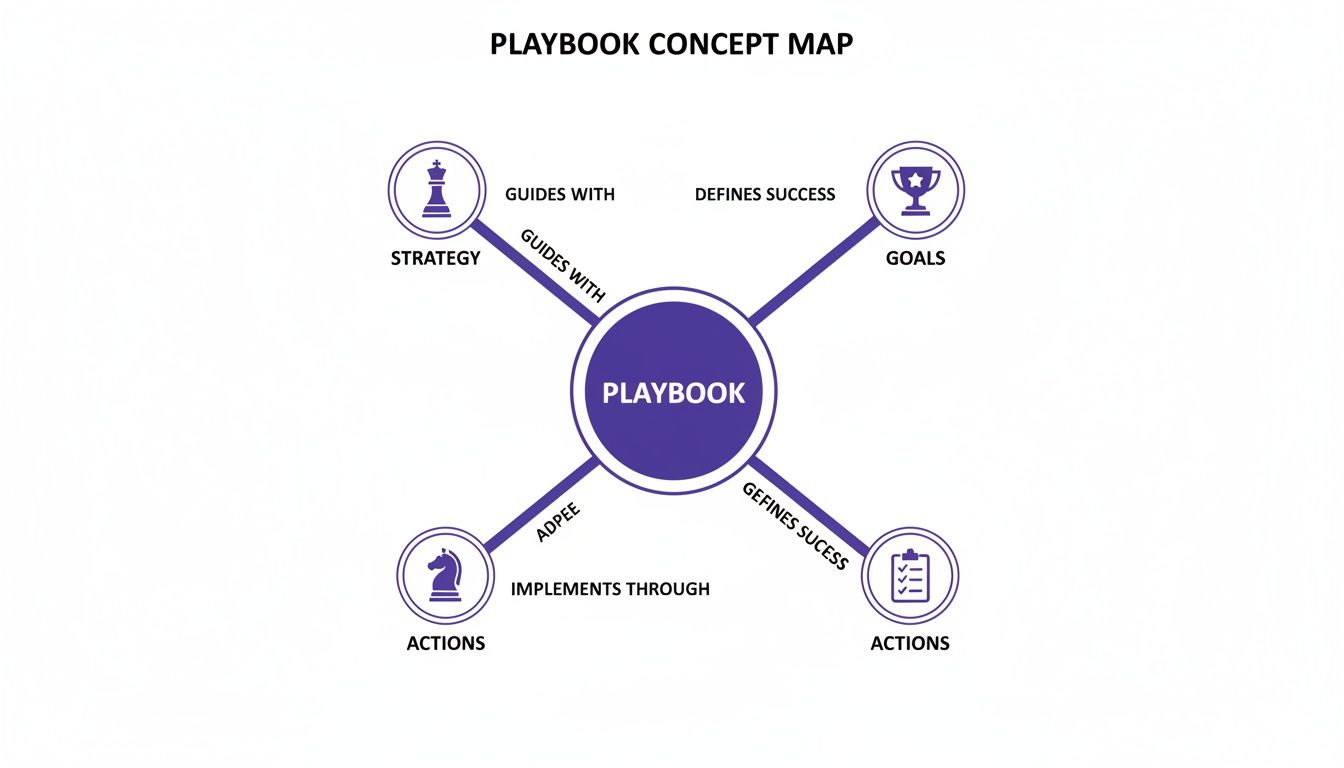
As you can see, the playbook is a strategic tool. Its job is to orchestrate a coordinated response by making sure all the different moving parts are working together toward a common goal.
Audience: Operators vs. Strategists
Who is this document for? The answer is completely different for a runbook than for a playbook, and that difference shapes the tone, format, and level of detail you’ll find in each.
- Runbook Audience: These are for your frontline operators, support staff, and junior engineers. They need crystal-clear, unambiguous instructions to get their job done. The content here is technical, granular, and straight to the point.
- Playbook Audience: This is for your incident commanders, senior engineers, and leadership teams. These are the people responsible for making critical judgment calls under pressure. The content is strategic, focusing on objectives, options, and decision-making frameworks.
The financial motivation to get this right is huge. According to the IBM Cost of a Data Breach Report 2023, organizations with an incident response team that regularly tested their plans saved an average of $1.49 million compared to those that didn’t. This proves just how valuable it is to have both tactical runbooks for operators and strategic playbooks for leaders.
To build a truly resilient operation, you need a solid framework of documentation. By understanding the distinct purpose, scope, and audience for runbooks and playbooks, you can give your teams the right tools to act with both precision and strategic intelligence when it matters most. You can learn more about the different types of documentation that can strengthen your organization in our related guide.
When to Use a Runbook Vs. a Playbook
So, when do you actually need a runbook, and when is a playbook the right call? The choice boils down to a single, critical question: Are you tackling a predictable, repeatable task or navigating an unpredictable, complex event?
Getting this right is crucial. If you hand someone a rigid runbook during a dynamic crisis, you’ll cause paralysis. On the other hand, giving them a high-level playbook for a simple, routine job just creates confusion and slows everything down. You have to match the tool to the job.
Scenarios Demanding a Runbook
A runbook shines when the process is well-defined, the steps are concrete, and the outcome is always the same. It’s built for environments where consistency and precision are non-negotiable.
You’ll want a runbook for situations like these:
- Routine Server Maintenance: Think patching, restarting services, or clearing out old logs. These tasks follow the exact same steps every single time, and getting them right is critical to avoiding downtime.
- Standard Operating Procedures (SOPs): Onboarding a new hire, spinning up a new virtual machine, or processing a customer refund all follow a specific, linear workflow. A runbook ensures everyone does it the same way.
- Resolving Common Support Tickets: When a Tier 1 support agent gets a familiar request—like a password reset or a printer that won’t connect—a runbook gives them the exact, step-by-step instructions for a fast fix.
In all these cases, the entire point is to stamp out variation and human error. The runbook becomes the single source of truth, empowering even junior team members to execute tasks perfectly.
Situations That Call for a Playbook
Playbooks are for the moments when things get messy. They come into play when you’re facing a complex event where the path forward isn’t clear and you need to make strategic decisions on the fly. A playbook provides a framework for navigating the chaos, not a simple checklist.
Pull out a playbook for scenarios such as:
- Responding to a Zero-Day Vulnerability: By definition, no one has a pre-written script for a brand-new threat. A playbook would outline roles, communication channels, and containment strategies to guide the incident response team.
- Managing a Major Cloud Service Outage: When a provider like AWS or Azure has a major failure, a playbook helps the team activate disaster recovery, update customers, and make smart decisions about service failover.
- Navigating a Public Relations Crisis: A PR playbook defines the communication strategy, identifies who is authorized to speak, and provides guidelines for managing the company’s reputation during a high-stakes event.
A playbook doesn’t give you all the answers; it equips you with the right questions to ask and the framework to find the best possible solution under pressure.
How Runbooks and Playbooks Work Together
Experienced teams know that the “runbook vs. playbook” debate isn’t about choosing one over the other. The real answer is “both.” They aren’t competing tools; they are complementary parts of a smart operational strategy.
Think of it this way: a high-level playbook for a major incident will almost always point to several smaller, more specific runbooks. For instance, a “Service Outage Playbook” lays out the overall strategic response but will link directly to tactical runbooks for execution, like:
- A runbook for “Failover to Secondary Server.”
- A runbook for “Post Status Page Update.”
- A runbook for “Restore Database from Backup.”
This is how you move from chaotic, reactive firefighting to a controlled, strategic response. The playbook sets the “what” and “why,” while the runbooks provide the precise “how” to get it done right.
Create Engaging Video Runbooks and Playbooks with AI
While text-based runbooks and playbooks are the default, let’s be honest: they can be dense and hard to follow, especially when you’re under pressure. A clear visual guide is almost always better when time is of the essence. Video tutorials offer a much more engaging way to guide someone, drastically improving how well they understand the task and reducing mistakes along the way.
But creating good video documentation has always been a pain. Traditionally, you’re stuck between two bad options. On one side, you have easy-to-use recorders like Loom. They’re simple to use, sure, but easy recording often leads to videos that are 50-100% longer than necessary. They’re full of ums, ahs, wrong clicks, and rambling that just confuses the viewer.
On the other side, you have professional video editing software such as Camtasia or Adobe Premiere Pro. These can create beautiful, polished videos, but they require expert video editing knowledge, creating a major bottleneck. The subject matter experts (SMEs)—the people who actually know the process inside and out—can’t create the videos themselves.
Bridge the Gap with AI-Powered Video Creation
Thankfully, a new generation of AI tools is changing the game. With Tutorial AI, you can generate professional video tutorials based on simple screen recordings. It’s designed to let your team’s SMEs create polished, on-brand videos without any of the usual hassle.
The process is remarkably efficient. Tutorial AI’s tools let you speak freely without any practice and still produce a video that looks as professional as if it was edited in Adobe Premiere Pro. The SME can just hit record and capture their knowledge in its rawest form. Then, the AI steps in, automatically transcribing the audio, refining the script, adding a studio-quality voiceover, and applying smart visual edits like zooms and highlights. This allows the subject matter expert to create on-brand videos extremely efficiently.
The real magic of AI-driven video creation is that it empowers the person with the most knowledge—the subject matter expert—to also be the creator. It removes the technical hurdles of video editing and lets them produce polished, on-brand videos with incredible speed.
From Raw Demo to Polished Tutorial in Minutes
This completely transforms how you can create both runbooks and playbooks. A step-by-step runbook becomes a crystal-clear video guide that leaves no room for error. A high-level playbook can be enhanced with short video demos that explain tricky decision points or show how to use specific tools.
This workflow is perfect for generating a wide range of essential video content from raw screen recordings:
- Demos and Onboarding Videos: Show exactly how a product or process works for new users and employees.
- Explainer and Feature Release Videos: Announce new capabilities with engaging, easy-to-follow walkthroughs.
- Knowledge Base and Support Article Videos: Answer common questions visually to cut down on support tickets.
To really get the most out of creating video runbooks and playbooks, you’ll want to explore tools that offer advanced features, like those covered in this YouTube Shorts Automation Guide with AI. The ability to turn a raw screen recording into a polished tutorial is a massive advantage. It ensures your team has exactly what they need to perform at their best, whether they’re handling a routine task or navigating a full-blown crisis. For a closer look at the process, check out our guide on how to create training videos with AI.
Runbook Vs Playbook FAQ
Even after you’ve got the definitions down, some practical questions always seem to pop up when you’re trying to decide which document to use. Let’s tackle some of the most common ones to help you see how these tools really work in the real world.
Can a Playbook Contain Runbooks?
Yes, absolutely. In fact, more mature organizations often do this as a best practice. Think of it this way: a high-level playbook for something like a “Major System Downtime” will map out the overall strategy. It defines who’s in charge of what and how everyone communicates.
Within that strategic document, the playbook will point to specific runbooks for the hands-on, tactical work. For example, a step in the playbook might say, “Initiate database failover,” and that text will link directly to the “Database Failover Runbook.” This creates a clean, effective hierarchy. Leadership gets the strategic overview from the playbook, while the folks on the front lines have the exact, step-by-step instructions they need from the runbook.
Are Runbooks and Playbooks Only for IT?
Not at all. While they definitely got their start in IT operations and cybersecurity, the underlying ideas are useful just about anywhere. The concept of providing strategic guidance (playbook) and standardizing a specific procedure (runbook) is a proven way to make any department more consistent and efficient.
Here are a few examples from outside the tech world:
- A sales team might use a “New Market Entry Playbook” to guide its overall strategy for expansion.
- An HR department could create a “New Employee Onboarding Runbook” to make sure every new hire has the same great experience.
- A marketing team could rely on a “Product Launch Playbook” to coordinate all the moving parts of a major release.
How Often Should These Documents Be Updated?
This really depends on how often the process itself changes. Runbooks, especially those tied to a specific piece of software or system, need to be checked and updated whenever that technology is modified. There’s nothing worse than having outdated instructions cause a problem during a critical moment.
Playbooks, on the other hand, can be reviewed on a more regular schedule—maybe quarterly—and always after a major incident. The post-incident review is your golden opportunity to capture lessons learned and refine your strategy for the next time around.
Using modern tools for video documentation makes the update process so much easier. Instead of having to re-record a whole tutorial from scratch, you can just edit the specific sections that have changed. It’s a simple way to keep your guides accurate without a ton of extra work.
What Is the Role of Automation?
Automation is a game-changer, particularly for runbooks. Many of the individual tasks within a runbook can—and should—be automated with scripts. This boosts speed and cuts down on the risk of human error. In this setup, the runbook becomes the human-friendly guide that explains what the automation does and gives you the manual steps to follow if the script fails.
Playbooks then act as the conductor, orchestrating the response by triggering these automated runbook steps. For instance, a security playbook for a potential data breach might instruct an analyst to kick off an automated containment script. The nitty-gritty details of that script are documented and managed within its own dedicated runbook.
Creating clear, engaging, and easy-to-update video runbooks and playbooks is simpler than ever. With Tutorial AI, your subject matter experts can record their screen and let AI handle the rest—producing polished, on-brand video tutorials in minutes, not days. See how it works.