Imagine taking your best-performing video and instantly making it fluent in the languages of millions of potential new customers. That’s the real power of video translation services. You’re not just translating content; you’re transforming a single video into a global growth engine that connects with audiences far beyond your home market.
Why Video Translation Is Your Next Growth Lever
In a world where online content flows freely across borders, publishing videos in only one language is like running a shop with the doors only halfway open. You’re leaving a massive amount of opportunity on the table. Video translation is much more than just swapping out words; it’s about making your tutorials, product demos, and marketing videos genuinely resonate with people around the globe.
Taking this step can unlock some serious benefits for your business:
- Expand Your Market Reach: Speak directly to potential customers in their own language. This builds immediate trust and makes entering new markets so much smoother.
- Deepen User Engagement: When viewers can effortlessly understand your message, they stick around longer. They watch more, interact more, and actually absorb what you’re trying to say.
- Build an International Brand: Consistently delivering high-quality, multilingual content positions your brand as a credible and authoritative global player.
The Exploding Demand for Multilingual Video
The move toward global content isn’t just a passing trend—it’s a fundamental shift in how people consume media. The numbers tell the story. The entire language services industry is on track to hit USD 114.1 billion by 2034.
More specifically, multimedia localization (which includes video) is growing at a staggering 12.79% CAGR. This boom is driven by platforms like YouTube, where over 70% of viewers are outside the US and expect subtitles or dubbing to properly engage with content.
The takeaway here is crystal clear: if your video content isn’t multilingual, you’re essentially invisible to a huge and rapidly growing majority of the global audience.
Driving Growth and Engagement
For any business, this all comes back to performance. One of the biggest upsides of going global with your content is the chance for significant growth, especially when it comes to mastering YouTube audience retention across different cultures. When your content feels local, it connects on a deeper level and keeps viewers hooked.
Suddenly, your video library is no longer just a cost center. It becomes a powerful asset that actively drives growth. By investing in video translation, you’re not just making more videos; you’re multiplying the impact and ROI of every single one you’ve already produced. It’s an essential part of any serious global strategy.
Subtitles vs. Dubbing: An Essential Breakdown
So you’ve decided to translate your video. Now comes the big question: how? This is one of those crossroads where I see content creators and marketers get stuck. The choice between subtitles and dubbing isn’t just a technical detail—it fundamentally shapes how your new audience experiences your content. It affects everything from budget and timelines to viewer engagement and even your video’s search ranking.
Making the right call is the very first step in a solid video translation services strategy.
Here’s a simple way to think about it. Subtitling is like reading a great book in translation; you still get the original author’s voice and rhythm, just with text to guide you. Dubbing, however, is the full movie adaptation—a completely immersive experience where you don’t have to read a thing.
Neither is universally “better.” The best choice depends entirely on your video, your audience, and what you’re trying to achieve. For anyone creating tutorials, product demos, or training videos, this decision is critical.
Subtitles and Captions: The Accessible Choice
Subtitles are simply the text version of your video’s dialogue, displayed on-screen while the original audio plays underneath. They’re quick, cost-effective, and in many parts of the world, viewers actually prefer them. It allows them to hear the original speaker’s authentic tone and emotion.
But there’s a crucial distinction to make. While subtitles translate speech, captions also describe important non-speech sounds, like “[mouse clicking]” or “[upbeat music].” This makes your content accessible for people who are deaf or hard-of-hearing, which for many businesses isn’t just a nice-to-have but a legal requirement.
One of the biggest hidden perks of subtitling? SEO. Search engines can’t watch a video, but they can read text. Your subtitle and caption files give Google a complete script of your content, helping your video rank for keywords in every language you target. For teams who need to move fast, subtitles are the perfect entry point into video localization. If you’re ready to get started, you might find our guide on how to add captions to videos helpful.
Dubbing and Voice-Over: The Immersive Experience
Dubbing goes a step further by completely replacing the original voice track with a new one recorded in the target language. This creates a much more passive, “lean-back” experience for viewers since they don’t have to split their attention between the action on screen and the text at the bottom. It’s the go-to method for high-production marketing videos or complex tutorials where you need the viewer’s full attention.
You’ll generally see two main styles of dubbing:
- Voice-Over: Common in documentaries and e-learning, this is where the new language track is layered on top of the original audio, which remains faintly audible. It lends an air of authenticity, like having an expert interpreter.
- Lip-Sync Dubbing: This is the most complex and expensive approach. It requires professional voice actors and painstaking audio engineering to make the new dialogue match the speaker’s lip movements on screen. The result is a seamless, completely natural viewing experience.
Choosing Your Video Translation Method
To help you decide, here’s a quick breakdown of how these methods stack up against each other based on what matters most: viewer experience, cost, and complexity.
| Method | Best For | Viewer Experience | Typical Cost & Effort |
|---|---|---|---|
| Subtitles | E-learning, social media, SEO-focused content, tight budgets. | Requires reading. Preserves original speaker's tone. Preferred in some cultures. | Low cost, fastest turnaround. |
| Captions | All public-facing and internal content requiring accessibility (WCAG/ADA compliance). | Essential for deaf or hard-of-hearing viewers. Useful in sound-off environments. | Low cost, slightly more effort than subtitles to add sound cues. |
| Voice-Over | Documentaries, corporate training, interviews, and informational content. | Informative and clear. The original voice adds a layer of authenticity. | Medium cost and effort. Requires voice talent and audio mixing. |
| Lip-Sync Dubbing | Feature films, marketing ads, high-production videos aiming for full immersion. | Seamless "lean-back" experience. Feels native to the viewer. | High cost, most complex and time-consuming. |
Ultimately, your choice will balance your production goals with the expectations of your target audience.
For many SaaS companies, the challenge isn’t just translation; it’s the raw footage itself. Product experts, not professional actors, are usually the ones recording demos. They might hit record on a tool like Loom and create a walkthrough that’s often 50-100% longer than necessary, full of “ums,” “ahs,” and long pauses.
In the past, the only way to fix this was to hand it off to a video editor with expensive software like Adobe Premiere Pro or Camtasia. This is where the workflow has dramatically improved.
With a tool like Tutorial AI, your subject matter expert can just speak naturally and record their screen without worrying about perfection. The platform’s AI can then automatically edit that raw take—trimming dead air, tightening up the pacing, and smoothing everything out. It transforms a rambling screen recording into what looks and sounds like a professionally edited video, ready for translation. This makes it possible for anyone on the team to create polished, on-brand content without ever touching a complex video editor.
How AI Is Changing the Game for Video Translation
Not long ago, taking a video global was a massive headache. The process was slow, expensive, and involved a long chain of handoffs between transcriptionists, translators, voice actors, and video editors. This old-school, manual assembly line created so many bottlenecks that scaling video content for different markets was a pipe dream for most.
But now, artificial intelligence is completely upending that old workflow. It’s moving us away from clunky manual tasks and toward smart, automated systems.
From the first transcription to the final voiceover, AI is speeding up every single step. This makes high-quality video translation services a real possibility for teams of any size, not just a luxury for massive corporations. We’re seeing this play out especially with screen-recorded tutorials, product demos, and knowledge base videos—the very content that drives customer education and sales.
From Raw Screen Recordings to Polished Tutorials
Think about a product expert who needs to create a video tutorial based on a screen recording. These videos are essential for demos, onboarding, explainers, feature releases, knowledge bases, and support articles. In the past, they had two options: write and rehearse a detailed script (which takes forever) or get a dedicated video team involved.
Today, it’s far more common to just hit “record” on an easy-to-use tool like Loom and talk through the process. It’s fast, but there’s a big catch. That raw footage is often 50-100% longer than necessary. It’s cluttered with pauses, filler words like “um” and “ah,” and moments where the speaker restarts a sentence to get it right. The result? A video that feels rambling and unprofessional, struggling to keep a viewer’s attention.
The traditional fix was to hand this footage to a video editor, who would then spend hours slicing and dicing it in professional software like Camtasia or Adobe Premiere Pro. This required expert video editing knowledge and added a lot of time and money to the project.
Tutorial AI’s tools are built to solve this exact problem. They let you speak freely without any practice, and your video will still look professional, as if it was edited in Adobe Premiere Pro. Tutorial AI allows the subject matter expert to become the creator. The platform’s AI acts like an expert editor, automatically analyzing raw footage and tightening it into a crisp, professional video. This allows the expert to create on-brand videos extremely efficiently, without needing to become a video wizard.
Smart Workflows for a Global Scale
The real magic of AI in video translation goes well beyond just cleaning up the initial recording. Modern platforms integrate the entire localization process into one seamless workflow.
Here’s how that looks for different types of video content:
- Demos and Explainer Videos: A product marketer records a single walkthrough, and the AI generates accurate scripts and voiceovers for multiple languages.
- Onboarding and Training Videos: An L&D manager can create one master training course and instantly spin up localized versions for global teams.
- Knowledge Base and Support Videos: A support specialist can quickly record a fix for a common issue and make it accessible to customers anywhere in the world.
A few key AI features make this kind of automation possible. After translating the script, for example, the platform can generate a lifelike AI voice generator for videos. It can even clone the original speaker’s voice to keep the sound consistent across all translated versions. This completely eliminates the need to hire and manage separate voice actors for every language.
On top of that, a feature like Tutorial AI’s AutoRetime automatically adjusts the video’s timing for each new language. A translated sentence might be longer or shorter than the original English, and this function intelligently re-syncs all the visuals—like zooms, highlights, and cuts—to match the new narration perfectly.
The Bigger Picture: AI’s Impact on Content Creation
This shift toward AI-powered efficiency isn’t just happening in video. The same ideas of automation and intelligent content generation are popping up all over marketing. For instance, exploring how to use AI for social media marketing shows how these principles can simplify content creation and distribution in other areas, much like they do for video translation.
Ultimately, AI-powered video translation puts the power back in the hands of the person who knows the material best: the subject matter expert. By getting rid of technical hurdles and inefficient handoffs, it frees up teams to create more content, reach more people, and get a much better return on their entire video strategy.
Finding the Right Balance of AI and Human Expertise
When it comes to video translation services, people often frame it as a showdown: human experts versus artificial intelligence. But from my experience, that’s the wrong way to look at it. The real goal isn’t to pick a winner, but to build the right workflow for the job at hand. It’s all about making smart trade-offs between cost, speed, and the level of quality you actually need.
For some video projects, a pure AI solution is a no-brainer—it’s just unbelievably fast. For others, nothing can replace the nuance of a human touch. The secret is knowing when to use each approach and, more importantly, how to blend them together for the best results.
When AI-Powered Speed Is Your Top Priority
Think about all the content that fuels your day-to-day business operations: internal onboarding videos, knowledge base tutorials, quick feature updates, and customer support demos. For this kind of material, the mission is simple: get clear, accurate information to your teams and customers fast, often across several languages at once.
This is exactly where AI-driven tools have a massive advantage. They completely sidestep the traditional bottlenecks that bring translation projects to a grinding halt.
- Screen Recordings: Imagine an engineer recording a quick demo with a tool like Loom. They can just talk through the process naturally, without worrying about a perfect script.
- Raw Footage: These recordings are almost always 50-100% longer than they need to be, full of “ums,” pauses, and restarts.
- The AI Editor: Instead of needing a video pro on Adobe Premiere Pro or Camtasia, a platform like Tutorial AI can ingest that raw footage and polish it automatically. It takes a messy, off-the-cuff recording and turns it into a professional video that looks like it took hours to edit.
For the person who actually knows the subject matter inside and out, this is a game-changer. It lets them create polished, on-brand videos without any video editing skills, transforming a major time-sink into a simple, straightforward task.
The Irreplaceable Value of a Human Touch
While AI is fantastic for speed and scale, it hasn’t quite mastered the art of human subtlety. For your most important content—think high-stakes marketing campaigns, emotional brand stories, or videos targeting specific cultural groups—a human-in-the-loop process is absolutely essential.
Professional translators and voice actors bring a layer of understanding that machines are still years away from replicating. They instinctively catch idiomatic phrases, local cultural references, and shifts in tone that an algorithm would likely miss. This is especially true for dubbing, where the emotional weight behind a line can make or break the entire viewing experience.
The market data backs this up. Multimedia localization is growing at a staggering 12.79% CAGR, largely because brands are chasing that authentic connection. They’re willing to pay 40-60% more for high-quality lip-sync dubbing and culturally sensitive voice-overs because they know it delivers a far greater return.
The Hybrid Model: Post-Edited Machine Translation (PEMT)
So, what’s the sweet spot for most businesses? It’s rarely pure AI or pure human. It’s a smart combination of the two, a hybrid model known as Post-Edited Machine Translation (PEMT). This approach gives you a powerful balance of machine efficiency and human oversight.
A typical PEMT workflow is beautifully simple:
- AI First Pass: An advanced AI engine translates the video script first, generating a solid draft in just a few seconds.
- Human Review: A professional human translator then steps in. They review and refine the AI’s output, correcting any awkward phrasing and making sure the language aligns perfectly with your brand voice and the target culture.
- AI Voice Generation: With the polished script ready, you can feed it into an AI voice generator for videos to produce a clean, consistent voice-over instantly.
This method truly gives you the best of both worlds. You get the raw speed and scale of AI to do the heavy lifting, paired with the critical eye and nuanced skill of a human expert to ensure flawless quality. It’s the perfect setup for teams who need to create top-tier localized content without blowing their budget or timeline.
Human vs AI Video Translation At a Glance
To make sense of these different approaches, it helps to see them side-by-side. The best choice always depends on your specific priorities—whether that’s raw speed for internal training or broadcast-level quality for a global ad campaign.
| Factor | Human Translation | AI Translation (e.g., Tutorial AI) | Hybrid (AI + Human Review) |
|---|---|---|---|
| Speed | Slow (Days/Weeks) | Very Fast (Minutes) | Fast (Hours/Days) |
| Cost | High | Low | Moderate |
| Quality | Highest (nuance, emotion) | Good (literal accuracy) | High (accurate & natural) |
| Scalability | Low (hard to scale) | Very High (unlimited) | High (scalable with resources) |
| Consistency | Varies by translator | Perfect | High (with style guides) |
| Best For | Marketing, cinematic content, brand storytelling | Internal training, support videos, knowledge bases | E-learning, corporate videos, product demos |
Ultimately, there is no single “best” method. The smartest localization strategies are flexible, using pure AI for high-volume, low-risk content and reserving human expertise for the high-impact projects where nuance and cultural connection matter most. The hybrid model sits right in the middle, offering an excellent balance for the majority of business needs.
Video Translation Use Cases That Drive Real Results
It’s one thing to talk about video translation in theory. It’s another to see how it solves real, everyday business problems. Smart companies aren’t just checking a box; they’re strategically using translated video to make their teams more efficient, close deals faster, and keep customers happy all over the world.
Let’s look at a few proven plays from different departments that are turning multilingual video into a serious advantage.
Cut Down on Global Support Tickets with a Multilingual Knowledge Base
Here’s a classic scenario: a support team is getting swamped with tickets from international customers. The problem isn’t that they lack answers—it’s that their helpful English video tutorials are completely useless to someone who doesn’t speak the language. This leaves customers frustrated and the support queue endlessly long.
By translating their video library, they can flip this situation on its head.
- The Pain Point: An overwhelming number of support tickets from non-English speakers asking the same basic questions.
- The Fix: Translate the entire library of how-to videos and troubleshooting guides into the languages spoken in their top customer regions.
- The Payoff: A massive drop in repetitive support tickets. Customers can now help themselves instantly, which means support agents are free to tackle the truly complex issues that require a human touch.
Deciding how to translate—focusing on speed with AI or polish with human experts—is a crucial part of the strategy. This flowchart breaks down that decision process.
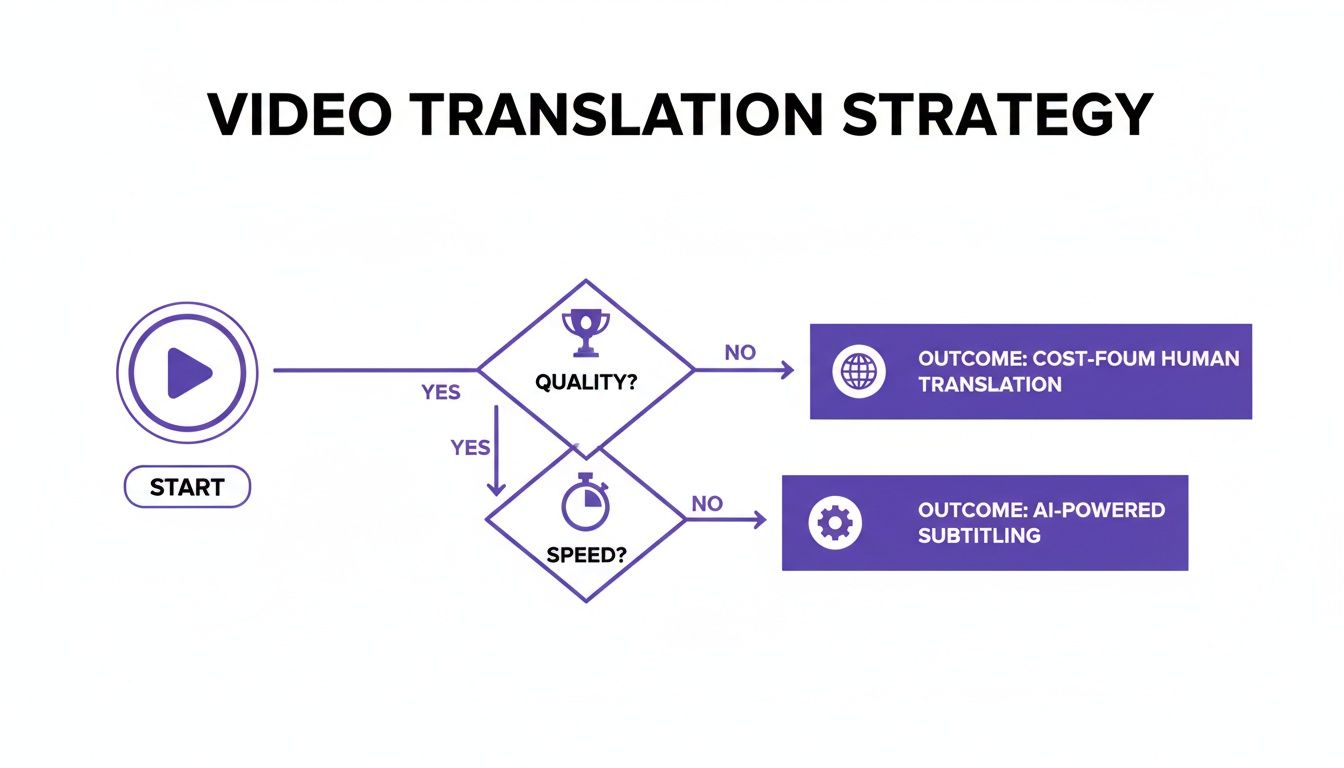
As you can see, your priorities will point you toward the right tool for the job, whether that’s a quick AI-powered solution or a more nuanced human-led project.
Accelerate Sales with Localized Product Demos
Now, let’s look at a sales team. They’re trying to break into new international markets, but their standard English product demos just aren’t connecting. That language barrier creates immediate friction, slowing down the sales cycle and making it incredibly difficult for reps to show a product’s true value.
By localizing their most important sales videos, they give their global team a powerful tool.
- The Pain Point: The sales cycle stalls because international prospects can’t fully grasp the product’s benefits from an English-only demo.
- The Fix: Create dubbed or subtitled versions of key product demos for each target country. Reps can now send videos that speak directly to prospects in their own language.
- The Payoff: Deals move through the pipeline much faster. When prospects feel understood, trust is built, and they are far more likely to become customers.
Create a Consistent Global Onboarding Experience
For any Learning & Development (L&D) team, consistency is the name of the game. When your company is hiring people across different continents, it’s a massive challenge to give everyone the same high-quality onboarding and training.
This is where video translation makes a world of difference.
You can create a single “master set” of training videos and then translate them for global deployment. Suddenly, every new hire—whether they’re in Tokyo, Berlin, or São Paulo—gets the exact same core message and a unified onboarding experience. It’s how you build a strong, cohesive company culture from day one. This isn’t a niche need, either. The translation services market is projected to hit USD 97.65 billion by 2031, and the IT and telecom sector drives 32.55% of that demand. That figure underscores just how critical it is for trainers to localize internal content for their global teams. You can discover more market insights on the translation services market from Mordor Intelligence.
How to Choose the Right Video Translation Partner
Alright, you’ve decided to translate your videos. Now comes the hard part: picking the right partner or platform to get the job done. This decision is a big one, as it will shape everything from your budget and timelines to the quality of the final product that reaches your global audience.
It’s easy to get lost in a sea of options, from old-school agencies to new-fangled AI tools. The key is to think of this not as hiring a vendor, but as finding an extension of your own team. A great partner helps you create high-quality global content efficiently and can grow with you. Let’s walk through how to make the right choice.
A Practical Checklist for Evaluating Solutions
When you start comparing services, it’s helpful to have a checklist. This isn’t about ticking boxes, but about asking the right questions to see who truly fits your needs.
- Quality and Accuracy: What does the finished product actually look and sound like? If you’re looking at AI solutions, do they have a “human in the loop” option for post-editing (PEMT)? Always ask for samples or, even better, run a small pilot project. You need to see how they handle your content.
- Language Coverage: Does the provider cover the languages your customers actually speak? Don’t forget about important regional dialects. For example, a generic Arabic translation won’t work for the 60 million people who speak Levantine Arabic. Details like this make all the difference.
- Workflow Integration: How will this tool plug into the way you already work? The last thing you want is another complicated step. Look for integrations with your existing CMS or LMS. The goal here is to make your life easier, not harder.
- Scalability: Think about the future. A solution that’s perfect for translating five videos might completely fall apart when you need to do fifty. Can the platform handle a bigger workload without your costs and effort skyrocketing?
Look Beyond the Price Tag
It’s tempting to just pick the service with the lowest price per minute, but that’s a classic mistake. This approach completely misses the Total Cost of Ownership (TCO), which includes all the hidden costs, like your team’s time spent managing projects and fixing sloppy translations.
The most cost-effective solution is the one that makes your team the most productive. A platform that saves your subject matter experts hours on every video by automating editing and localization delivers a far greater return than a service that’s cheap but slow and cumbersome. Think about the time you’ll save. Some companies have found that working with smart localization partners—those who blend technology with real cultural know-how—can produce a 345% ROI simply by making their internal processes more efficient.
Ultimately, choosing a video translation partner is an investment in your brand’s global reputation. You’re not just buying a service; you’re investing in quality and efficiency. Make sure the partner you select strengthens all three.
Frequently Asked Questions
Stepping into the world of video translation services can feel a bit overwhelming, especially with technology changing so quickly. Let’s clear up some of the most common questions people have.
How Much Does It Really Cost to Translate a Video?
There’s no single price tag; think of it more like a spectrum. On one end, you have quick, AI-generated subtitles for a short clip, which can be incredibly affordable. On the other, you have a full-blown, lip-synced dub for a one-hour training module, which requires professional voice actors and audio engineers, bumping the cost up considerably.
The final price really boils down to a few key things:
- Translation Method: Simple subtitles are the most budget-friendly option, while perfect lip-sync dubbing sits at the top end of the price range.
- Video Length: Naturally, the longer your video, the more it will cost to translate.
- Number of Languages: Each new language you add is another layer on top of the total project cost.
- Quality Level: A pure AI translation is the cheapest route. Adding a human-in-the-loop for review (PEMT) will cost more but adds a crucial layer of quality control.
How Long Does Video Translation Take?
The biggest shift we’ve seen is in turnaround time. Projects that used to take weeks of back-and-forth between translators and video editors can now, in some cases, be done in hours.
An AI platform, for example, can often transcribe, translate, and create a new voiceover for a five-minute video in less than 30 minutes. However, if your project requires a human touch for review or high-end dubbing, you’ll need to build in more time. A hybrid approach might take a day, while a completely human-led project could still take a week or more, depending on its complexity.
Can AI Really Capture Language Nuances?
This is a great question. Modern AI is fantastic at delivering literal translations with impressive speed and accuracy. For internal how-to guides or straightforward support videos, this is often all you need.
Where AI can still stumble is with cultural nuances, local idioms, and the emotional delivery that a professional human translator instinctively understands.
That’s why a hybrid workflow—pairing AI’s speed with human expertise—is so powerful. You get the efficiency of machine translation for the heavy lifting, plus the critical final polish from a human expert who can ensure the tone and cultural context are just right.
What Is the Best First Step to Start a Translation Project?
Before you even think about vendors or technology, the best first step is to clarify your goal. What are you actually trying to achieve?
Are you hoping to reduce support tickets from your users in France? Or are you planning a major product launch across all of Latin America? Your objective will point you directly to the right translation method, quality standard, and budget. Once that’s clear, you can start evaluating your options with confidence.
Ready to turn your raw screen recordings into polished, multilingual tutorials without all the usual headaches? Tutorial AI uses AI to handle the tedious editing and translation, letting your team create professional-quality demos and support videos in minutes.