
In the fast-paced world of software development, documentation is often an afterthought, a task rushed at the end of a sprint. Yet, it's the silent force that drives user adoption, reduces support costs, and empowers developers. Exceptional documentation is more than just a manual; it's a core part of the user experience. It can be the difference between a frustrated user churning and a loyal advocate who champions your product.
This guide moves beyond generic advice to provide a comprehensive roundup of the 10 most impactful software documentation best practices for 2025. We'll explore actionable strategies for organization, writing, versioning, and leveraging multimedia, giving you the tools to transform your documentation from a simple reference into a powerful asset. To truly leverage your documentation as a strategic asset, consider how it fits into broader organizational efforts to implement effective training and retain intellectual capital by following these knowledge management best practices.
We will also demonstrate how to implement many of these practices using modern tools. For instance, creating polished video tutorials, a cornerstone of effective documentation, has historically required a choice between two imperfect options. Easy-to-use recording tools like Loom are great for quick captures, but the final video is often 50-100% longer than necessary. On the other hand, professional video editing software such as Camtasia or Adobe Premiere Pro requires expert video editing knowledge.
A new generation of tools bridges this gap. With Tutorial AI, you can generate video tutorials based on screen recordings for demos, onboarding videos, explainer videos, feature release videos, knowledge base videos, and support article videos. Its tools let you speak freely without any practice, and still your video will look professional, as if it was edited in Adobe Premiere Pro. This allows the subject matter expert to create on-brand videos extremely efficiently.
1. Write Clear and Concise Documentation
The most fundamental of all software documentation best practices is to prioritize clarity and conciseness. Your goal is to create content that is immediately understandable to the widest possible audience, from novice users to seasoned developers. This means stripping away unnecessary jargon, simplifying complex concepts, and getting straight to the point. Clear documentation empowers users to find answers independently, which drastically reduces the burden on support teams and enhances overall user satisfaction.

This practice is non-negotiable for any type of documentation, whether it's an internal knowledge base, a public-facing API guide, or a user onboarding tutorial. When a user is confused or frustrated, clear documentation is their fastest path to a solution. Companies like Stripe and Slack excel at this, with API references and user guides that are models of clarity, using simple language and logical structure to guide users effectively.
How to Implement This Practice
To achieve this level of clarity, adopt a user-centric mindset and follow these actionable steps:
- Use Readability Tools: Integrate tools like the Hemingway Editor or Grammarly into your workflow. They can help you identify overly complex sentences, passive voice, and common grammatical errors that hinder comprehension.
- Read Aloud: Before publishing, read your documentation out loud. This simple technique helps you catch awkward phrasing and run-on sentences that might look fine on the page but are confusing to a reader.
- Seek External Feedback: Ask someone outside your team, especially a non-expert, to review your work. If they can understand it without prior context, you are on the right track.
- Structure for Scannability: Break down large topics into smaller, digestible sections. Use descriptive headers, bulleted lists, and bold text to highlight key information, allowing users to scan the document and find what they need quickly.
2. Maintain Up-to-Date Documentation
Outdated documentation is worse than no documentation at all. It erodes user trust, leads to incorrect implementation, and creates a flood of preventable support tickets. This is why maintaining up-to-date documentation is one of the most critical software documentation best practices. Your documentation must evolve in lockstep with your product, reflecting every new feature, bug fix, and API change.
Neglecting this practice turns your knowledge base into a source of misinformation. Leading tech companies like Microsoft and AWS invest heavily in keeping their Azure and cloud service documentation current, often updating articles multiple times a month. Similarly, frameworks like React use robust versioning systems to ensure users can always find documentation relevant to the specific version they are using. This commitment to currency is non-negotiable for building a reliable and authoritative resource.
How to Implement This Practice
To prevent your documentation from becoming obsolete, integrate its maintenance directly into your development lifecycle with these steps:
- Integrate into Your "Definition of Done": Make updating relevant documentation a required task for any new feature or change to be considered complete. This ensures documentation never lags behind the product.
- Create Release Checklists: Develop a standard documentation checklist for every product release. This should include updating tutorials, API references, and release notes to reflect the new changes.
- Schedule Regular Audits: Set recurring calendar reminders for quarterly or biannual audits of your entire knowledge base. Systematically review content for accuracy, identify stale articles, and archive or update them accordingly.
- Implement a Feedback Mechanism: Add a simple "Was this helpful?" widget or a feedback form to your documentation pages. This allows users to flag outdated or confusing content, creating a direct channel for identifying areas needing attention.
3. Use Code Examples and Sample Projects
Abstract concepts and theoretical explanations are useful, but for developers, code is the ultimate source of truth. One of the most impactful software documentation best practices is to embed practical, working code examples and link to complete sample projects. This approach transforms documentation from a passive reference guide into an active learning tool, allowing users to see exactly how your software works in a real-world context.
This practice is essential for any technical documentation, especially for APIs, SDKs, and developer frameworks. Well-crafted examples dramatically reduce the learning curve, accelerate implementation, and serve as a quick-start template for developers. Documentation platforms like MDN Web Docs and Firebase excel at this, offering interactive code snippets and copy-paste examples that let developers test concepts directly in their own projects, solidifying their understanding and boosting their confidence.
How to Implement This Practice
To make your documentation more actionable with code, follow these key steps:
- Keep Examples Focused: Each code snippet should illustrate a single concept or function. Avoid combining multiple complex ideas into one example, as this can confuse the user. Start with the basics before introducing advanced use cases.
- Explain the "Why": Don't just show the code; explain why it is written that way and the problem it solves. Add comments within the code and provide a brief explanation of the logic and expected output.
- Ensure Code is Testable and Current: Regularly test all code examples to confirm they are functional and up-to-date with the latest version of your software. Broken code is a major source of user frustration and erodes trust in your documentation.
- Link to Full Projects: For more complex workflows, provide links to complete, runnable sample projects hosted on platforms like GitHub. This allows developers to see how different components fit together in a larger application.
4. Structure Documentation Logically and Organize Hierarchically
Even the clearest writing can be ineffective if users can't find it. Structuring your documentation logically and organizing it hierarchically is a critical software documentation best practice that makes information discoverable and understandable. This involves creating a clear information architecture, grouping related topics, and providing intuitive navigation so users can effortlessly locate answers and grasp the relationships between different concepts. A well-organized documentation site acts as a roadmap, guiding users from foundational knowledge to advanced topics without confusion.

This practice is essential for preventing user frustration and building confidence in your product. A disorganized knowledge base forces users to hunt for information, leading to wasted time and increased support tickets. Excellent examples of logical structure can be seen in Figma's help center and the Kubernetes documentation, which use a clear hierarchy of concepts, guides, and references to cater to users at all skill levels, making complex systems feel approachable.
How to Implement This Practice
To build a strong foundation for your documentation, focus on creating a thoughtful and consistent structure from the outset.
- Design Information Architecture First: Before writing a single word, map out your documentation structure. Create an outline that defines main categories (e.g., "Getting Started," "API Reference," "Tutorials") and the sub-topics within each. This ensures content is placed logically.
- Use Consistent Heading Levels: Strictly follow a heading hierarchy (H1, H2, H3, etc.) to create a clear visual and structural flow. This not only improves readability but also helps search engines and screen readers understand your content's organization.
- Implement Navigational Aids: Include elements like a persistent sidebar, a comprehensive table of contents for long articles, and breadcrumb navigation. These tools help users understand where they are within the documentation and easily move between related sections.
- Leverage Documentation Generators: Use tools like Hugo, Jekyll, or Docusaurus to build your documentation site. These frameworks often come with built-in features for creating structured, navigable, and searchable documentation sites, saving significant development time.
5. Include Visual Aids and Diagrams
Text alone often fails to convey complex workflows or abstract software concepts effectively. One of the most impactful software documentation best practices is to incorporate visual aids, such as screenshots, diagrams, flowcharts, and videos. These elements complement text by providing immediate context, reducing cognitive load, and catering to different learning styles. Visuals make documentation more engaging and significantly improve information retention.
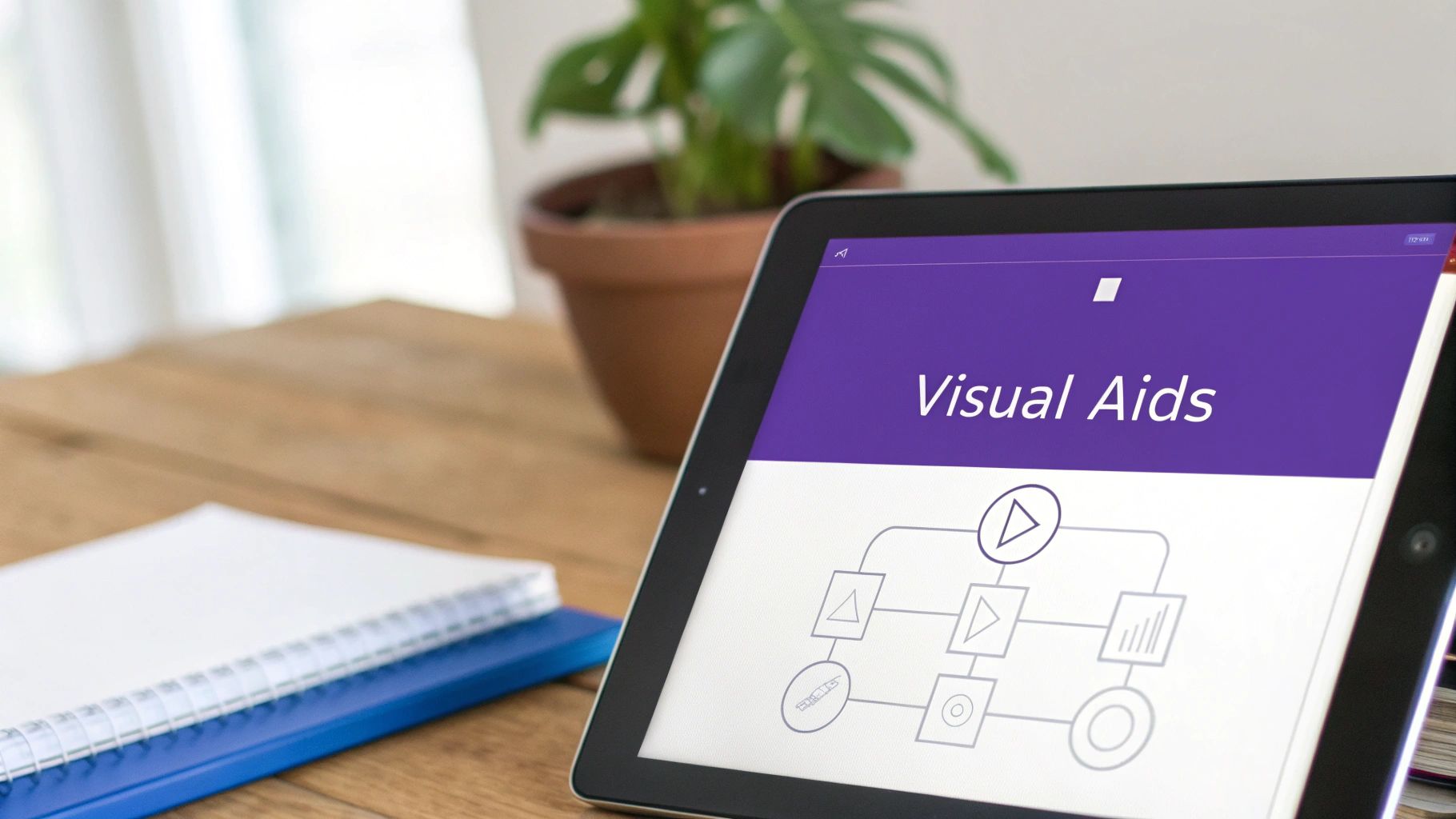
This practice is crucial when explaining user interfaces, architectural flows, or multi-step processes. Well-placed visuals can transform a confusing block of text into a clear, intuitive guide. Companies like Canva and Shopify excel at this, using annotated screenshots and step-by-step visual guides to make their platforms accessible to everyone, regardless of technical skill. The goal is to show, not just tell, making the user's journey smoother and more successful.
How to Implement This Practice
To effectively integrate visuals into your documentation, focus on clarity, consistency, and purpose:
- Annotate Screenshots: Use arrows, boxes, and brief text labels to highlight key interface elements on your screenshots. This directs the user's attention precisely where it needs to be, preventing confusion.
- Use Diagramming Tools: Create professional flowcharts, mind maps, and architectural diagrams with tools like Lucidchart or draw.io. These are invaluable for illustrating process flows and system relationships.
- Maintain Visual Consistency: Establish a consistent style for all visual aids, including color schemes, fonts, and annotation styles. This creates a cohesive and professional look across your entire knowledge base.
- Create Video Tutorials: For dynamic processes, video is unparalleled. Use screen recordings to create demos, onboarding guides, and feature release videos. Instead of spending hours on complex tools like Adobe Premiere Pro, you can use script-first editors to let subject matter experts record freely and produce professional, on-brand videos with minimal effort. This approach to screen recording for training is extremely efficient.
- Ensure Accessibility: Always provide descriptive alt text for images and diagrams. This ensures that users with visual impairments who rely on screen readers can still understand the content conveyed by the visual.
6. Document APIs and Interfaces Thoroughly
For software that integrates with other systems, comprehensive API documentation is not just a best practice; it is a critical component for adoption and success. This involves meticulously detailing every public API, function, class, and interface, providing precise descriptions of parameters, return values, and potential error codes. This level of detail directly impacts developer experience (DX), as developers rely on this information to build integrations quickly and correctly.
This practice is essential for any product with a developer-facing component. Incomplete or ambiguous API documentation leads to frustrated developers, increased support tickets, and slow integration cycles. Companies like Stripe and GitHub are often praised for their API references, which are clear, interactive, and exhaustive. They serve as the gold standard for developer-centric documentation that accelerates, rather than hinders, development. For practical examples of thorough API documentation that demonstrates clarity and structure, you might explore resources like these API documentation examples.
How to Implement This Practice
To create world-class API documentation that empowers developers, focus on standardization and interactivity:
- Use an API Specification: Adopt a standard like the OpenAPI Specification (formerly Swagger). This provides a machine-readable format for describing your API, which can then be used to automatically generate interactive documentation, client libraries, and even mock servers.
- Provide Code Snippets: For each endpoint, include example requests and responses in various popular programming languages (e.g., Python, JavaScript, cURL). This allows developers to copy, paste, and test your API with minimal effort.
- Document Every Detail: Clearly distinguish between required and optional parameters. Document all possible HTTP status codes and provide meaningful error messages so developers can build robust error-handling logic.
- Create an Interactive Sandbox: Implement an API explorer or sandbox directly within your documentation. This allows developers to make live API calls, experiment with different parameters, and see real responses without leaving the browser, dramatically speeding up their learning process.
7. Implement Search Functionality
Even the most well-structured documentation can become difficult to navigate as it grows. A robust search function is no longer a luxury; it’s a critical tool that empowers users to find specific information instantly. Implementing an effective search is one of the most impactful software documentation best practices for improving user experience, especially for extensive knowledge bases or complex API references. It transforms your documentation from a static library into an interactive, on-demand resource.
This practice is essential for any documentation set that contains more than a handful of pages. When a developer is debugging an issue or a user is trying to perform a specific task, they need answers fast. A powerful search saves them from manually clicking through categories and hierarchies. Documentation platforms like those for Google Cloud and AWS are excellent examples; their search capabilities allow users to pinpoint exact commands, service details, and tutorials from millions of words of content, drastically reducing frustration and time-to-solution.
How to Implement This Practice
A powerful search experience goes beyond a simple text-matching field. To build a truly helpful search function, follow these actionable steps:
- Use a Dedicated Search Service: Instead of building from scratch, integrate a dedicated search solution like Algolia or Meilisearch. These services are optimized for speed, relevance, and typo tolerance, providing a superior user experience out of the box.
- Make the Search Bar Prominent: Place the search bar in a highly visible and consistent location on every page, typically in the main header. This ensures users can access it immediately, no matter where they are in the documentation.
- Analyze Search Queries: Regularly review what users are searching for. Failed searches or frequently repeated queries can highlight confusing terminology, missing content, or documentation gaps that need to be addressed.
- Provide Contextual Suggestions: Implement features like autocomplete, contextual suggestions, and "did you mean?" corrections. This helps guide users toward the correct terminology and discover relevant articles they might not have known to search for directly.
8. Create Getting Started Guides and Tutorials
While comprehensive reference documentation is essential, its primary purpose is to serve as an encyclopedia. For new users, a different approach is needed. One of the most impactful software documentation best practices is to create dedicated getting started guides and tutorials. These resources are designed to help beginners achieve their first "win" with your product as quickly as possible, which significantly improves user retention and creates a positive initial experience.
Unlike feature-oriented reference docs, tutorials are goal-oriented. They guide users through a specific, practical workflow from start to finish. This hands-on approach builds confidence and demonstrates the software's value proposition immediately. Platforms like Django and Flutter excel at this with their famous "Write your first app" tutorials, which are often a new developer's first point of contact and a key reason for their high adoption rates.
How to Implement This Practice
To build effective onboarding materials, focus on action and immediate results. Follow these steps to craft guides that empower new users:
- Assume Zero Prior Knowledge: Start from the absolute beginning. Avoid making assumptions about what the user already knows about your system, its terminology, or the underlying technology. Explain every step clearly.
- Provide Starter Projects: Reduce setup friction by offering downloadable templates or pre-configured starter projects. This allows users to dive straight into the core functionality without getting bogged down in initial configuration.
- Set Clear Expectations: Include an estimated completion time and a clear description of what the user will have accomplished by the end of the tutorial. This helps them commit to the process.
- Use Task-Oriented Video: Create video tutorials that show the process in action. Recording a quick demo with a tool like Loom is easy, but the resulting videos are often 50-100% longer than necessary. Instead of relying on complex editors like Adobe Premiere Pro, you can use a tool like Tutorial.AI. It allows subject matter experts to record freely and then automatically edits the footage into a professional, on-brand video, turning a raw screen recording into a polished tutorial with maximum efficiency. You can learn more about how to design effective educational content by reviewing these instructional design best practices.
9. Write for Your Target Audience
One of the most impactful software documentation best practices is tailoring content to the specific needs, goals, and expertise of your readers. Generic documentation often fails because it either overwhelms beginners with technical jargon or frustrates experts with overly simplistic explanations. By understanding who you are writing for, you can create content that is genuinely helpful, relevant, and effective, directly improving user adoption and satisfaction.
This practice is crucial for complex software with varied user bases. For example, AWS and Salesforce excel by providing distinct documentation paths for developers, administrators, and business users. Each audience gets content structured and written in a way that matches their context and objectives. This audience-first approach ensures that every user finds the precise information they need without wading through irrelevant material, making your documentation a powerful enablement tool rather than a frustrating obstacle.
How to Implement This Practice
To effectively write for your audience, you must first understand them deeply. Use these strategies to gather insights and tailor your content:
- Develop User Personas: Create detailed profiles of your key audience segments. Include their job titles, technical skills, primary goals for using the software, and potential pain points. Keep these personas visible as you write to maintain focus.
- Conduct User Research: Go directly to the source. Use surveys, interviews, and feedback forms to ask users what they find confusing and what information they need most. Tracking which documentation pages are most visited also provides valuable data on user priorities.
- Provide Multiple Entry Points: Structure your knowledge base with clear, role-based navigation. For instance, a homepage could have distinct sections like "For Developers," "For Project Managers," and "For New Users," guiding each group to a tailored experience.
- Use Clear Labeling: Implement tags or labels like "Beginner," "Advanced," or "Administrator" on articles. This helps users self-select the appropriate content and sets clear expectations about the technical depth of the information.
10. Gather User Feedback and Analytics
Creating documentation is not a one-time task; it's a continuous process of refinement. A crucial software documentation best practice is to establish systems for gathering user feedback and analyzing usage data. This data-driven approach transforms documentation from a static resource into a dynamic asset that evolves with your users' needs, helping you identify confusing articles, uncover content gaps, and prioritize improvements based on real-world behavior.
This practice is essential for ensuring your documentation remains relevant and effective over time. By actively listening to your audience, you can direct resources to the most impactful areas, reduce support tickets, and demonstrate the value of your documentation efforts. Companies like MDN Web Docs and GitHub excel at this, incorporating feedback buttons and surveys directly into their documentation pages, making it effortless for users to report issues or suggest improvements.
How to Implement This Practice
To turn your documentation into a feedback-driven ecosystem, integrate the following strategies into your workflow:
- Implement Simple Feedback Mechanisms: Add a simple "Was this article helpful? Yes/No" widget at the end of each page. This low-effort tool provides a quick pulse on content performance and flags articles that need immediate attention.
- Analyze Usage with Analytics: Integrate a tool like Google Analytics into your documentation site. Track key metrics such as page views, time on page, bounce rate, and most importantly, the search terms users enter. This data reveals what users are looking for and where they are struggling to find it.
- Create a Feedback Loop: When users submit feedback, acknowledge it and act on it. Use a system to turn feedback into trackable issues or tickets. When a change is made based on a user's suggestion, close the loop by notifying them. This builds community and shows you value their input.
- Conduct Periodic User Research: Go beyond passive data collection by conducting interviews or surveys with your users. Ask them about their experience with the documentation, their common challenges, and what content they wish existed. This qualitative insight provides context that quantitative data often lacks.
Software Documentation: 10 Best Practices Comparison
From Documentation to Empowerment
The journey from mediocre documentation to a truly empowering user resource is built on a foundation of deliberate, strategic choices. We've explored the essential pillars of this foundation, moving beyond generic advice to uncover actionable software documentation best practices that drive tangible results. It’s not just about writing things down; it’s about creating an ecosystem of support that anticipates user needs, reduces friction, and fosters genuine product mastery.
By now, it's clear that exceptional documentation is a living entity. It demands a commitment to clarity and conciseness, ensuring every sentence serves a purpose. It requires diligent maintenance to remain current and trustworthy, reflecting the latest product updates. Most importantly, it thrives on a deep understanding of its audience, speaking their language and addressing their specific pain points, whether they are a new user following a "Getting Started" guide or a developer dissecting an API reference.
Synthesizing the Core Principles
Let's distill the most critical takeaways from our exploration. The most effective documentation strategies are multi-faceted, blending strong writing with thoughtful organization and rich media.
- Structure is Non-Negotiable: A logical, hierarchical structure, complemented by powerful search functionality, is the bedrock of usability. Without it, even the best-written content becomes an undiscoverable, frustrating mess. Users must be able to find what they need, when they need it.
- Show, Don't Just Tell: Static text has its limits. The integration of visual aids, from simple diagrams and screenshots to comprehensive code examples, transforms abstract concepts into concrete understanding. This multi-modal approach caters to different learning styles and significantly accelerates comprehension.
- Embrace the Feedback Loop: Your documentation is not finished when you hit "publish." It is a product in its own right and must be treated as such. Actively gathering user feedback and analyzing usage metrics are essential practices for continuous improvement, ensuring your content remains relevant, helpful, and effective.
The Power of Multimedia in Modern Documentation
One of the most significant shifts in modern documentation is the move towards dynamic, engaging content. This is where the power of video tutorials comes into sharp focus. While traditional screen recordings made with tools like Loom are easy to create, they often end up being 50-100% longer than necessary, filled with pauses and mistakes. On the other hand, professional editing software like Adobe Premiere Pro requires a steep learning curve and significant time investment, creating a bottleneck.
This is the precise gap that next-generation tools are designed to fill. By leveraging AI-powered, script-first editing, subject matter experts can record freely and naturally, knowing the final output will be a polished, professional video. Features like automatic cursor tracking and on-brand templates allow anyone to produce high-quality onboarding videos, feature explainers, or knowledge base tutorials with incredible efficiency. It democratizes video creation, empowering your most knowledgeable team members to become your most effective content creators. This shift is a cornerstone of modern software documentation best practices, turning passive manuals into active learning experiences.
Ultimately, elevating your documentation is an investment in your users. It’s a direct line to improving adoption rates, reducing support ticket volume, and building a loyal customer base that feels confident and capable. By implementing these practices, you are not just creating a manual; you are building a powerful engine for user success and long-term growth.
Ready to transform your static articles into engaging, professional video tutorials in minutes? Tutorial AI empowers your team to create on-brand, studio-quality videos from simple screen recordings, making it easier than ever to implement modern software documentation best practices. See how you can elevate your user experience and streamline content creation at Tutorial AI.



